

Many people decide to straighten their teeth as adults, to smile with more confidence or because crowded teeth are hard to keep clean. The first question is almost always the same: removable clear aligners, or fixed braces with brackets and a wire? Which one shows more, how often do you need to come in, is eating harder, and most of all, which one can actually correct your teeth?
The good news is that both work, and age is not a barrier. The American Association of Orthodontists says about 1 in 3 orthodontic patients today are adults. Several systematic reviews agree that clear aligners work well for mild to moderate problems, while fixed braces usually give more control in complex cases and for some precise tooth movements. So the real question is not which one is better in general, but which one fits your bite and the way you live.
This guide compares them point by point: how each one moves teeth, daily life, which bites suit which option and how strong the evidence is, what adults need to think about such as gums, crowns and implants, retainers afterward, and the usual steps of treatment. The aim is to help you understand your options and talk through your own plan with your dentist.
In short: clear aligners are removable clear trays worn about 20 to 22 hours a day, and they suit mild to moderate crowding, spacing and many bite problems. Fixed braces stay on the teeth, work without you having to remember them and give more control in complex cases. Both need a retainer afterward, and your dentist tells you which suits you after an examination and X-rays.
What this article covers: choosing between clear aligners and fixed braces as an adult. The causes of crowded teeth and buck teeth, and treatment that combines braces with jaw surgery, each have their own guide below.
Crowded or crooked teeth: causes, how space is made, and which braces suit you
Buck teeth: causes, treatment options and what suits your age
How teeth aligners move teeth
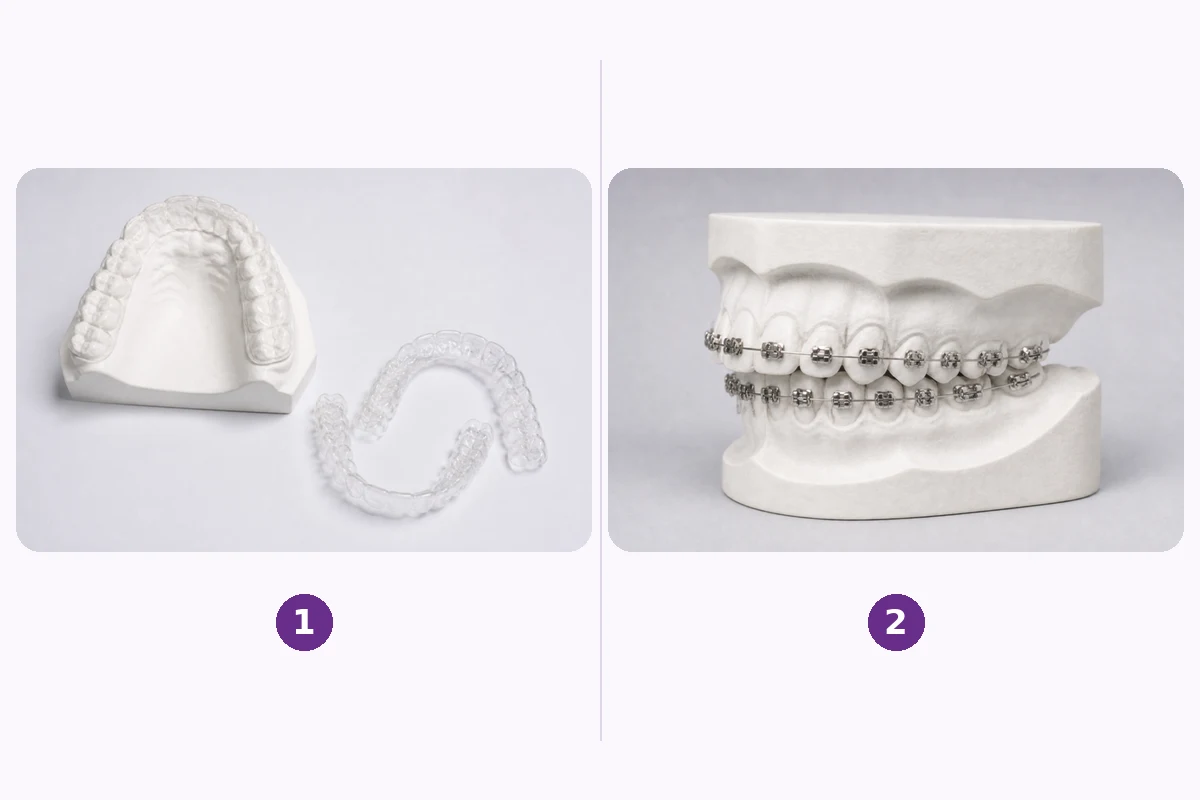
Each aligner is a clear plastic tray made to fit your teeth. Every tray in the series is slightly different from the one before, so each new tray nudges the teeth a little further along a plan made on a computer. Cleveland Clinic notes that a new tray is usually given about every two weeks.
Small tooth-colored bumps called attachments are bonded to some teeth so the trays can grip them and push in the right direction. If your plan needs a little extra space, a small amount of enamel may be polished between some teeth. The planned tooth movements are mapped on a computer from a scan or impressions of your teeth before the aligners are made.
Aligners only work while they are in your mouth, so how many hours you wear them matters as much as the plan itself. A 2020 systematic review also found that most tooth movements may not be predictable enough to finish with the first set of trays alone, so additional trays may be needed partway through to fine-tune the result.
How fixed braces move teeth
Fixed braces use small brackets bonded to each tooth, joined by a wire. The wire applies gentle, steady pressure that moves the teeth over time. The braces stay on for the whole treatment, and the wire or the elastics are adjusted at check-ups. Because you never take them out, the teeth receive pressure day and night without you having to think about it.
Fixed braces come in more than one look. Metal brackets are the classic type, and tooth-colored ceramic brackets show less. Both move teeth in the same way with a wire. Your dentist explains which type suits your case.
The NHS notes that braces can feel strange at first and the teeth may be sore for a few days after they are fitted. Soft food helps during those days. Cleaning around the brackets takes more time each day, and interdental brushes help reach under the wire.
Aligners and braces in daily life, side by side
| Topic | With clear aligners | With fixed braces |
|---|---|---|
| How it looks | Clear trays, with small tooth-colored attachments on some teeth. | Brackets and a wire on the teeth. Ceramic brackets show less than metal. |
| Eating | Take the trays out to eat and drink, then brush before putting them back. | The braces stay on. Avoid very hard or sticky food that can loosen a bracket. |
| Keeping clean | Brush and floss as usual with the trays out, and rinse and brush the trays every day. | Brush around every bracket and clean between the teeth daily. It takes longer. |
| Discipline | Works only while the trays are in, for about 20 to 22 hours a day. Results depend on you. | Works all the time on its own. You keep up the cleaning and the visits. |
| Check-up visits | Regular check-ups and new sets of trays. How often depends on your plan. | Regular visits to adjust the wire. How often depends on your plan. |
| First few days | Pressure for a few days with each new tray. | Tender teeth for a few days after fitting and after adjustments. |
| If something breaks | A cracked tray or one that does not fit: contact the clinic. | A loose bracket or a wire poking your cheek: contact the clinic. |
| Complex cases | Well suited to mild to moderate problems. | More control in severe cases and when teeth are taken out to make space. |
Which bites suit aligners, and which suit braces?
This table sums up the systematic reviews we read for this article. The strength of evidence is as the researchers rated it where they gave a rating, and otherwise summarized from the study designs and risk of bias they reported. Moderate means the finding is fairly reliable but could change with better studies. Low means it is a reasonable signal that still needs more research.
| Situation | What studies found | Strength of evidence |
|---|---|---|
| Mild to moderate crowding or spacing | Aligners were effective and can be used as an alternative to fixed braces. | Moderate: an overview of 18 systematic reviews, 2022 |
| Crowding treated without taking teeth out | No clear difference in the quality of the result or in treatment time. | Low to limited: reviews from 2024 and 2025 |
| Cases that need teeth taken out to make space | Fixed braces gave a better result, thanks to more control of tooth movement. | Limited: few trials, short follow-up |
| Severe malocclusion | Aligners were linked with poorer results than fixed braces. | Moderate: overview of reviews, 2022 |
| Settling the bite, root angle and widening the arch | Braces did better in several studies on these specific movements. | Limited: 2 randomized trials and 6 cohort studies, 2019 |
| The jaw position itself causes the bite problem | Orthodontic treatment may need to be combined with jaw surgery. | Decided case by case by the orthodontist and the surgeon |
Most studies follow patients for a short time, and some looked at only one aligner brand. The findings show a direction, not a verdict for every person. Your orthodontist puts them together with your bite, your X-rays and the health of your gums before recommending an option.
Braces with jaw surgery: the steps and how long it takes
Gums, comfort and tooth roots: what studies compare
Beyond straight teeth, adults often ask which option is gentler on the gums and the teeth. Here is what the reviews found, with the strength of evidence rated the same way as above.
| Topic | What studies found | Strength of evidence |
|---|---|---|
| Gum health during treatment | Slightly less plaque and gum inflammation with aligners on average, though not every review agrees. | Low: reviews from 2018 and 2023 |
| White spots on the enamel | Less plaque and fewer early white spots in aligner groups. | Moderate for plaque, with large differences between studies |
| Discomfort in the first days | In studies of Invisalign, people reported less pain in the first days. After that, there was no difference. | Moderate: mostly mild cases, 2020 |
| Shortening of tooth roots | Can happen with both. On average it was less common and milder with aligners. | Low: studies at moderate to serious risk of bias |
| Teeth moving back after treatment | One overview found more relapse after aligners; a 2025 review found similar stability. | Limited: short follow-up, so both need retainers |
In practice: if you are prone to gum inflammation or tooth decay, being able to take the trays out makes brushing easier. Whichever you choose, your daily cleaning is what keeps your gums healthy during treatment.
Which way do you lean? A quick checklist
Clear aligners may suit you if
- Your crowding, spacing or bite problem is mild to moderate.
- You can keep the trays in for about 20 to 22 hours a day, and take them out only to eat, drink and clean your teeth.
- You would like an option that is less visible at work or when you speak in public.
- You find cleaning around brackets hard, or your gums tend to bleed easily.
Fixed braces may suit you if
- Your case is complex, or your plan needs teeth taken out to make space.
- You know you might forget to put trays back after meals.
- You prefer braces that work on their own, rather than trays you take out and put back yourself.
- You are fine with regular visits to adjust the wire, at intervals your dentist plans with you.
See an orthodontist before deciding, if
- Your gums bleed often, or some teeth feel loose or have started to drift.
- Your lower front teeth sit in front of the upper ones, or your jaw looks uneven.
- You have jaw pain, clicking, or trouble opening your mouth wide.
What adults need to think about
There is no upper age limit for orthodontic treatment, and the AAO says about 1 in 3 orthodontic patients are adults. Adults are no longer growing, so some bite problems are corrected differently than in children, and adult mouths often have a history: gum disease, fillings, crowns or implants. These are the points worth talking through at your first visit.
Healthy gums come first
Generally, the gums and teeth are checked first, and any gum treatment or fillings needed are done before orthodontic treatment starts. For advanced gum disease, the European Federation of Periodontology guideline includes orthodontic tooth movement as part of rebuilding the bite, after the gum treatment has been completed and with regular re-checks during and after treatment.
Crowns, bridges and implants
Tell your orthodontist which teeth have crowns, bridges or implants. The American Academy of Implant Dentistry explains that implants are joined to the bone and do not move like natural teeth. That is why some dentists straighten the teeth before an implant is placed, so the space and the bite are right first. Braces can still help after an implant if the teeth around it need to move.
Jaw joints and the bite
If you have jaw pain, clicking or difficulty opening your mouth, mention it at the first visit so the joints can be checked and included in the plan. When the position of the jaws causes the bite problem, braces alone may not be enough, and orthodontic treatment can be planned together with jaw surgery.
Wear time and how long treatment takes
Aligners are worn about 20 to 22 hours a day, in the order given, and taken out only to eat, drink and clean your teeth. Some patient guides, such as Cleveland Clinic, suggest up to 22 to 23 hours a day, with a new tray about every two weeks. Wearing them for fewer hours can slow treatment down, because the teeth only move while the trays are in. Follow the wear time your dentist gives you for your plan.
Treatment time depends on your bite and usually ranges from about 6 months to two years, for braces and aligners alike. Studies on speed disagree: one review found shorter treatment with aligners, while a 2024 review found similar times in mild to moderate crowding, with low certainty. How long your own treatment takes depends on your case, and your dentist plans it with you.
A day with aligners
- Morning: take the trays out, brush and floss, rinse the trays, and put them back.
- Meals and drinks: take the trays out and keep them in their case, not in a napkin.
- After eating: brush your teeth before putting the trays back.
- Night: sleep with the trays in. Night hours count toward your daily total.
- Every day: rinse the trays and brush them gently to keep them clean.
A day with braces
- Brush with fluoride toothpaste in the morning, at night and after meals, around every bracket.
- Use an interdental brush between the teeth and under the wire once a day.
- Cut hard food into small pieces, and skip sticky food and chewing gum.
- Keep sugary drinks and snacks for mealtimes to protect the teeth around the brackets.
After treatment: both need retainers
Teeth tend to move back after treatment, whichever method straightened them. When treatment ends, a retainer is made, either removable or fixed behind the teeth. The Oral Health Foundation describes the usual pattern: day and night at first, then usually at night for the long term.
A Cochrane review of retainers after braces found that the evidence is low or very low certainty, so no single retainer type can be called better than the others. Wear yours exactly as your orthodontist instructs, and bring it to your check-ups.
How long to wear a retainer, when to wear it, and what to do if you miss nights or lose it
Common myths about aligners and braces
| Myth | Fact |
|---|---|
| Adults are too old for braces. | There is no upper age limit. The AAO says about 1 in 3 orthodontic patients today are adults. |
| Aligners are always faster. | Studies disagree. In mild to moderate crowding, treatment times were similar. |
| Aligners can only close small gaps. | They treat many mild to moderate crowding, spacing and bite problems. Some complex cases suit braces better. |
| Ordering aligners without seeing a dentist is the same thing. | In Thailand, the Dental Council and the Thai Association of Orthodontists state that aligner treatment needs a dentist from diagnosis and scanning through to retainers. |
| Once the braces come off, the teeth stay straight. | Teeth tend to move back. Retainers keep them in place after both braces and aligners. |
| A clear aligner, a clear retainer and a night guard are the same tray. | They look alike but do different jobs: an aligner moves teeth, a retainer holds them, and a night guard protects teeth from grinding. |
When to contact your orthodontist
Most of the time, treatment runs quietly between visits. These signs are worth a message or a call, so small problems are fixed while they are still simple.
| What you notice | What to do |
|---|---|
| Pain that lasts more than a few days after a new tray or an adjustment, or sharp pain | Contact the clinic so the orthodontist can check the fit. |
| Gums that are very red, swollen or bleeding | Keep brushing gently and contact the clinic for a check. |
| A tray that cracks or no longer fits | Contact the clinic before moving on to the next tray. |
| A loose bracket or a wire poking your cheek | Contact the clinic so it can be checked. |
| New jaw pain or clicking | Mention it to your orthodontist so the joints can be checked. |
Orthodontic treatment: the usual steps
New orthodontic patients are welcome at the clinic, for clear aligners and for fixed braces. The steps below are the usual order. The number of visits and the time each step takes depend on each case, and your dentist plans them with you.
- Consultation and records: the dentist examines your teeth and bite and takes the X-rays needed for planning, plus a digital scan or impressions of your teeth.
- Treatment before orthodontics: any cleaning, fillings, gum treatment or extractions your plan needs are usually done first.
- Planning: with aligners, the teeth are scanned and the planned tooth movements are mapped on a computer, so you can see them before the trays are made. With braces, the dentist explains the plan and the type of brackets that suits you.
- Starting: attachments are bonded and you are shown how to put the trays in and take them out, or the brackets are bonded and the wire is placed.
- Follow-up: regular check-ups to see how the teeth are moving. How often depends on your treatment and your plan.
- Finishing: attachments or brackets are removed and retainers are made to keep the teeth in place.
If radiation worries you: X-rays inside the mouth at the clinic are digital, and the CBCT has an Ultra Low Dose mode. Your dentist chooses the mode that suits each case, and X-rays are taken only when they are needed.
Questions that help you understand your plan
You do not need to learn all the terms. Asking about the things that help you understand your own plan is enough. For example:
- Do my teeth, gums and bite suit aligners, braces or both?
- Is there anything to treat first, such as gums or fillings, and does it change how long treatment takes?
- What other options do I have for my teeth?
- Do my health conditions or the medicines I take make a difference?
- How often will I need to come in, and how can it fit around my travel? Your dentist gives this for your case.
- How do I care for my teeth during treatment, and how do I look after them and the retainer in the long term?
- What will it cost? Price ranges are on the prices page.
Dental X-ray radiation: how much is it, and how we keep it low
Orthodontics and braces in Chiang Mai
If this sounds like you: choosing aligners or braces
These are example situations, not patient stories, to help you find the next step that fits.
- Your lower front teeth have crowded a little over the years and you give presentations at work: clear aligners are often a good fit, if you can keep them in for about 20 to 22 hours a day.
- You snack through the day and know you would forget the trays: fixed braces, perhaps tooth-colored ceramic ones, may suit you better because they work without you remembering.
- Your gums bleed when you brush and some teeth have started to drift: start with a gum check and gum treatment, then plan the orthodontics once the gums are stable.
- Your teeth are badly crowded and your dentist mentions taking teeth out to make space: fixed braces are often the better fit here, because studies found they give more control in these cases. Your dentist explains the options for your plan.
- You have an implant replacing a back tooth: tell your orthodontist at the first visit, because the implant stays where it is and the plan works around it.
- Your lower teeth close in front of your upper teeth and your chin looks prominent: the dentist checks whether the jaw position is involved, and whether braces combined with jaw surgery should be assessed.
- You live abroad and visit Chiang Mai a few times a year: say so before you start. The number of visits depends on each case, and your dentist plans the treatment with you around your trips.
Planning treatment from abroad
Frequently asked questions about aligners and braces for adults
Are clear aligners as effective as braces?
For mild to moderate crowding and spacing, reviews found results comparable to fixed braces. For severe cases, cases that need extractions and some precise movements, fixed braces did better. Your orthodontist tells you which applies to your bite after an examination and X-rays.
How many hours a day do I need to wear aligners?
About 20 to 22 hours a day. Some patient guides, such as Cleveland Clinic, suggest up to 22 to 23 hours. Take them out only to eat, drink and clean your teeth, and wear them while you sleep. Wearing them for fewer hours can slow treatment down. Follow the wear time your dentist gives you for your plan.
Which is faster, aligners or braces?
There is no fixed answer. Treatment usually takes about 6 months to two years with either option, and studies disagree on which is quicker. How long your own treatment takes depends on your case, and your dentist plans it with you.
Do aligners hurt less than braces?
Both cause some pressure or soreness for a few days after a new tray or an adjustment. In studies of Invisalign, people reported less pain than with braces in the first days, and after that the difference disappeared.
Am I too old for orthodontic treatment at 40 or 50?
No. There is no upper age limit. What matters more than age is the health of your gums and the bone around your teeth, which is checked first. Some bite problems are corrected differently in adults because the jaws are no longer growing.
Can I have orthodontic treatment if I have gum disease?
Often yes, once the gum disease has been treated and is stable. The gum treatment is done first, and your gums are checked regularly during orthodontic treatment. For advanced gum disease, moving teeth with orthodontics can be part of rebuilding the bite.
Can I get aligners or braces with an implant or crowns?
Usually yes, with careful planning. An implant does not move like a natural tooth, so the plan works around it. Tell your orthodontist about every crown, bridge and implant, so they can plan which teeth move and how.
Do I need a retainer after aligners?
Yes. Teeth tend to move back after any orthodontic treatment, so a removable or fixed retainer is made when treatment ends. Wear it as your orthodontist instructs and bring it to your check-ups.
How much do aligners or braces cost?
The cost depends on the type of treatment and how complex your bite is. Price ranges are on the prices page, and your dentist explains the cost for your own plan.
Summary
Clear aligners and fixed braces both straighten teeth. Aligners suit mild to moderate problems and people who can wear them for about 20 to 22 hours a day. Braces give more control in complex cases and work without you remembering them. Your dentist decides with you after an examination and X-rays.
- Mild to moderate crowding or spacing: both work, and aligners are a reasonable alternative.
- Severe cases or extractions: fixed braces usually give more control.
- Daily life: aligners come out to eat and clean, braces stay on and need careful cleaning around the brackets.
- Adults: treat the gums first and tell your orthodontist about crowns, bridges and implants.
- After treatment: both need retainers to keep the teeth in place.
References
American Association of Orthodontists: Adult orthodontics
American Academy of Implant Dentistry: What comes first, the braces or the implant?
Cleveland Clinic: Clear aligners, purpose and types