

Maybe a doctor has just said the words mandibular advancement device, or you saw a snoring mouthpiece online and wondered whether a medical one is any different. It is natural to have questions. What exactly goes into your mouth at night? Will it hurt your jaw? Will it move your teeth? And how is it different from a night guard for grinding?
The reassuring part is that a MAD is a simple, removable appliance with a long research record. It holds the lower jaw a little forward during sleep, and imaging studies show this widens the airway behind the soft palate and tongue. International guidelines prefer a custom-made appliance that can be adjusted in small steps, with a dentist checking your teeth and bite over time. Most early discomfort settles, and the longer-term bite changes are known and can be followed.
This guide is about the device itself. You will learn the parts and types, how it changes the airway, how it is made and adjusted step by step, which side effects to expect in the first weeks and over the years, who should wait or choose another option, and how to clean it and know when it needs checking.
In short: a medical MAD is a custom appliance that covers the upper and lower teeth and holds the lower jaw slightly forward during sleep, which widens the airway. Guidelines prefer a custom, adjustable two-piece design, moved forward in small steps until it works and stays comfortable. Early jaw or tooth soreness and extra saliva are common and usually settle, while slow bite changes over years are the reason for regular dental check-ups.
Scope of this article: whether your snoring needs a sleep test, how severe sleep apnea is graded and how a MAD compares with CPAP are covered in our article on MAD for snoring. Choosing between a night guard and a MAD is covered in its own guide.
MAD for snoring: how the mouthpiece helps snoring and sleep apnea
Night guard or snoring appliance (MAD): what is the difference?
What a medical MAD is
MAD stands for mandibular advancement device. Mandible means the lower jaw, and advancement means moving it forward. You may also see the names mandibular advancement splint (MAS), mandibular repositioning appliance (MRA) or simply oral appliance. They all describe the same idea: an appliance that fits over your teeth like a retainer and supports the lower jaw in a forward position while you sleep.
The word medical matters. A medical MAD is part of a treatment plan: a physician decides whether it suits your sleep problem, a dentist checks that your teeth, gums and jaw joints can carry it, and both follow up on the result. It is worn only at night, and it is taken out in the morning.
A MAD is a different appliance from a night guard for grinding. The guide linked at the top of this page explains how to tell them apart.
Snoring and sleep apnea appliance (MAD)
Parts and types of MAD
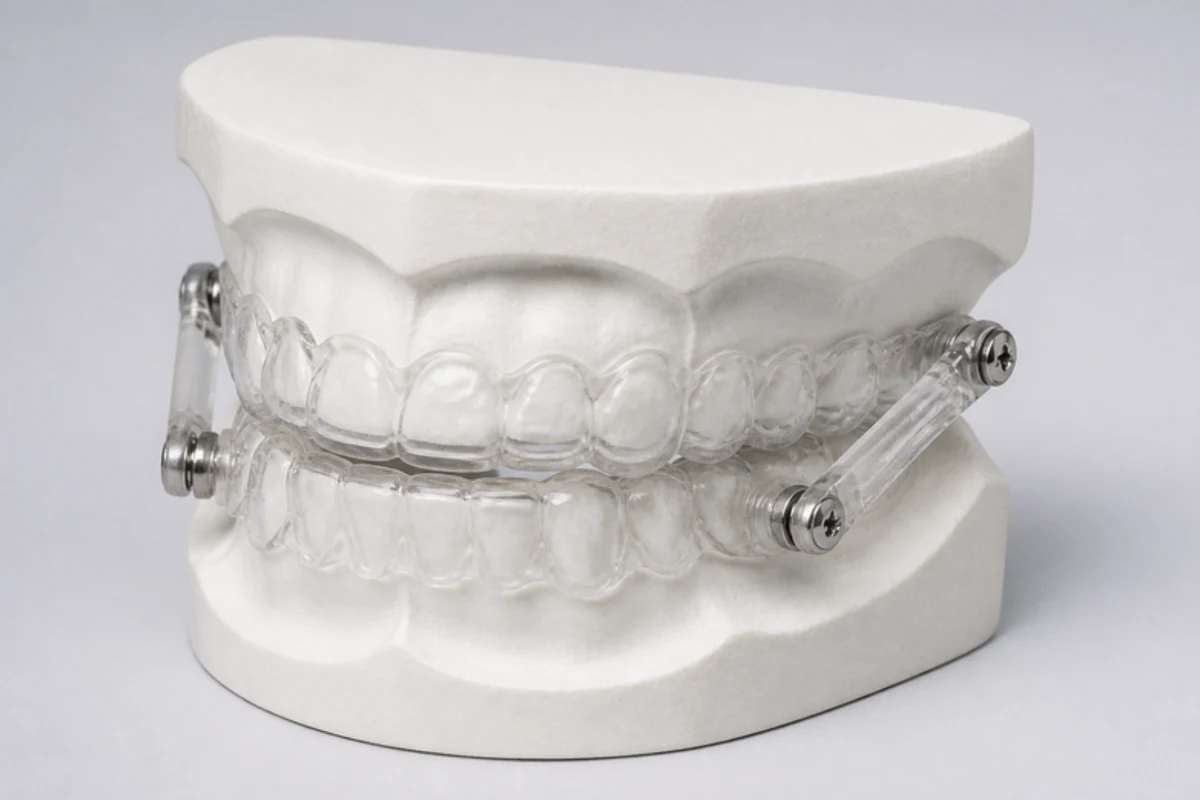
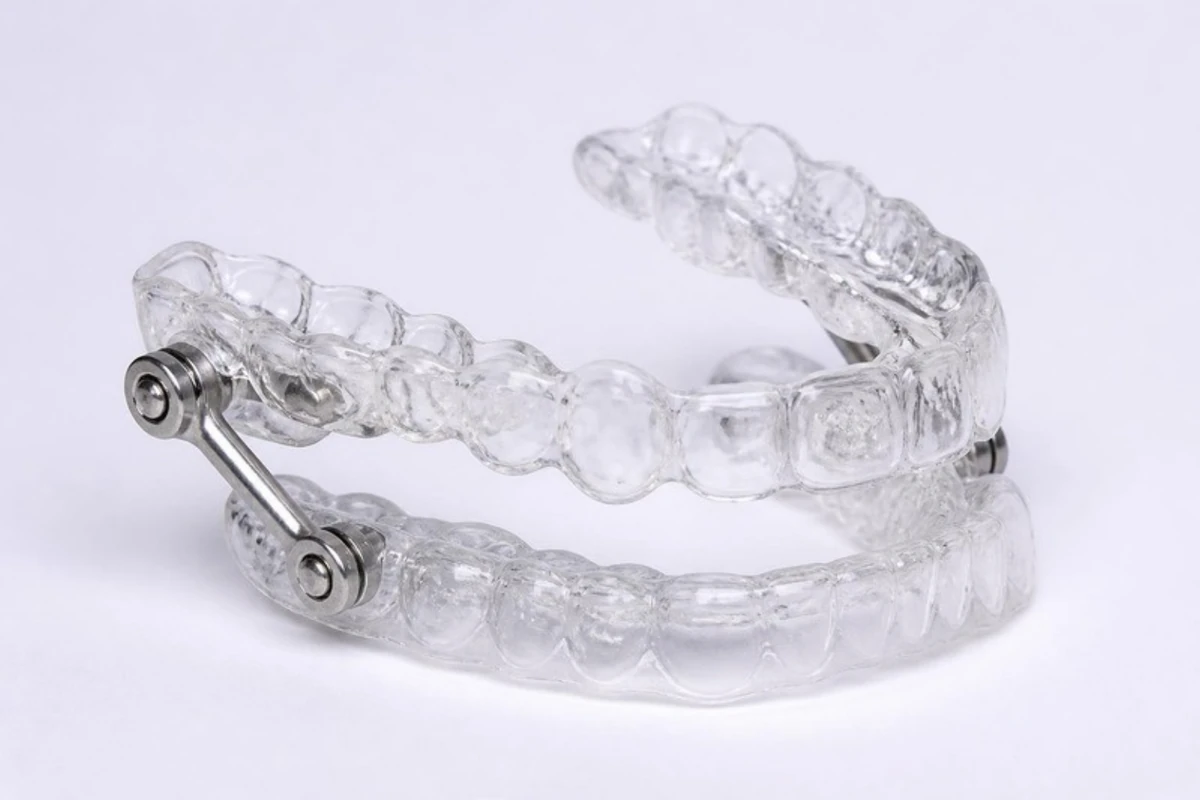
Every MAD has two trays, one for the upper teeth and one for the lower teeth, plus something that sets the lower tray forward. In one-piece designs the trays are joined into a single block. In two-piece designs they are separate and linked by connectors such as side arms, screws or fins, so the lower jaw can still open a little and move slightly side to side. The connectors are what make adjustment possible.
| MAD design | What it is like | What studies and guidelines say |
|---|---|---|
| One-piece (fixed) | Upper and lower trays joined in one block at a set forward position. | In a randomized trial of 302 patients, one-piece and two-piece appliances worked about equally in the short term, with similar mild side effects. |
| Two-piece, adjustable | Separate trays linked by connectors that can move the lower jaw forward or back in small steps. | The German dental sleep medicine guideline recommends a custom, adjustable two-piece design for adults. The AASM guideline suggests a custom, titratable appliance. |
| Ready-made (heat and bite) | A soft plastic tray shaped at home by softening it in hot water and biting into it. | In a crossover trial, it reduced sleep apnea less than a custom device, and one third of users stopped mainly because it did not stay in place. |
Custom-made or ready-made?
A custom appliance is made in a dental laboratory from impressions or a digital scan of your own teeth, so it grips firmly all night. In a randomized crossover study of 35 people with mainly mild sleep apnea, only the custom device lowered the number of breathing events per hour, it reduced snoring more, and 82 percent of participants preferred it. One third failed with the ready-made device, mostly because it did not stay in during the night.
Not every expert view is identical. A family-doctor guide from Australia notes that a large British trial found a semi-tailored device cost-effective in the short term. Still, the AASM guideline, the German guideline and the Sleep Health Foundation all point toward a device fitted by a dentist, because you will wear it for a long time and fit affects both comfort and side effects.
How it opens the airway
During sleep the muscles of the throat relax. In people who snore or have obstructive sleep apnea, the soft palate and the base of the tongue can fall back and narrow the airway. The tongue is attached to the lower jaw, so when the lower jaw is held forward, the tongue and nearby soft tissues are drawn forward too, and the tissues around the throat become more taut.
An MRI study of 69 people with sleep apnea looked at the airway with and without a custom MAD. With the device in place, total airway volume increased, mostly in the area behind the soft palate. The tongue base moved forward and the fat pads at the sides of the throat moved outward. In that group, the average number of breathing events fell from about 27 to about 12 per hour, and the widening was seen in people who responded to treatment, not in those who did not.
This explains two things you may hear from your doctor. First, a MAD does not work equally for everyone, which is why the effect on your sleep is checked after adjustment. Second, the amount of forward movement matters, which is why the device is adjusted in steps rather than set at the maximum on day one.
Who a MAD suits, and who should wait
A MAD is a treatment, so it starts after a diagnosis. Sleep apnea is diagnosed by a physician with a sleep test. We refer you to a hospital for the sleep test and coordinate your care. The full path from snoring to diagnosis is in the snoring article linked above. From the device side, these points help you see where you stand.
Is your mouth ready for a MAD?
- You have enough healthy teeth in both jaws to hold the trays.
- Your gums are healthy, or gum treatment can be finished first.
- You can move your lower jaw forward comfortably.
- You breathe through your nose comfortably at night.
Conditions to sort out or discuss first
| Condition | Why it matters for a MAD |
|---|---|
| Too few teeth, or loose teeth | The trays need teeth to hold on to. In one study of 100 consecutive patients with sleep apnea, 34 percent had a reason not to use a MAD, mostly too few remaining teeth. |
| Active gum disease or tooth decay | Teeth carry the forces of the device every night. Fillings and gum treatment are planned first. |
| Jaw joint pain or a jaw that hardly moves forward | The German guideline lists painful jaw joint problems and less than 5 mm of forward movement as higher-risk findings that need a careful look first. |
| Central sleep apnea | Here the brain does not send the signal to breathe, so moving the jaw forward is unlikely to help. |
| Mainly mouth breathing or a blocked nose | The appliance fills part of the mouth, so a clear nose matters. Your physician may look at the nose first. |
A dental implant, crown or bridge is not automatically a problem. A review in 2026 found only a few reports of oral appliances in people with implants, so your dentist plans these cases individually.
How a MAD is made
A MAD is built around your own teeth and your own jaw position. Guidelines describe these general steps.
- Dental examination: your dentist checks your teeth, gums and jaw joints, measures how far your lower jaw moves forward, and takes X-rays when needed.
- Dental treatment first, if needed: fillings or gum care are completed so the teeth can carry the appliance.
- Impressions or a scan: your dentist records the upper and lower teeth, either with impression material or a digital scanner.
- Recording the starting jaw position: a bite record captures the forward position the appliance will start from. The German guideline suggests a comfortable start at about half of your maximum forward reach, when that is possible.
- Making the appliance: the German guideline describes a custom MAD being made in a dental laboratory from the models or scan together with the bite record.
- Fitting: your dentist checks the fit and bite, and shows you how to put it in, take it out and clean it.
How many visits these steps take, and how long each one lasts, differs from person to person. Your dentist plans the timing with you.
A patient leaflet from a UK hospital suggests wearing a new appliance for short periods in the evening for the first day or two, before wearing it all night. Your dentist explains a settling-in routine that suits you.
Adjusting step by step (titration)
Titration means moving the lower jaw forward in small steps after you have got used to the appliance. The aim is the position that controls snoring and breathing pauses while still feeling comfortable. The German guideline recommends steps of 1 mm or less, and an appliance that allows at least 5 mm of forward adjustment and some backward adjustment. A review of titration methods found wide agreement that careful titration matters, but no single agreed protocol.
| Adjustment phase | What happens in this phase | Who looks after it |
|---|---|---|
| Getting used to it | You wear the appliance every night at the starting position. Mild tightness in the morning is common. | You, with advice from your dentist |
| Adjusting forward | The position is moved forward in small steps over the following weeks, checking snoring, comfort and jaw joints at each step. A Singapore patient leaflet describes this period as about four to six months. | Dentist who fits it |
| Checking the effect | Once the position feels right, the AASM guideline suggests a follow-up sleep test with the appliance in place to confirm the effect. | Your physician |
| Long-term MAD checks | Regular checks of the fit, teeth and bite. The German guideline suggests the first dental check 6 months after titration ends, then once a year. | Your dentist and physician together |
More forward is not always better. Moving too far too fast can strain the jaw muscles and joints, and a study of people who also used a morning guide found more front-tooth tipping when the jaw was set at 95 percent or more of its maximum reach. Your dentist balances effect against comfort at each visit.
Side effects in the first weeks and over the years
The AASM guideline notes that most side effects of oral appliances involve the teeth and jaws. In the randomized trial of 302 patients, about 4 in 10 reported side effects in the short term, and these were mild in both appliance types.
| MAD side effect | When it shows | How it is managed |
|---|---|---|
| Sore teeth or a tight jaw in the morning | First weeks, and after each adjustment | Usually settles with regular use. Jaw exercises shown by your dentist can help. |
| Bite feels different for a while after removing it | Mornings, usually for about an hour | Normal and temporary. Jaw exercises help the jaw settle back. |
| Extra saliva or a dry mouth | First weeks | Often settles. Tell your dentist if it continues. |
| Jaw joint or chewing muscle pain | More common in the first months | Your dentist may slow the adjustment or step back the position. |
| Slow change in how the teeth meet | Over years of use | Checked at regular dental visits so changes are seen early. |
What the long-term studies show
Long-term changes are mainly in the teeth, not the jaw bones. In a study of 77 people who wore a MAD for an average of about eleven years, the vertical and horizontal overlap of the front teeth decreased by around 2 mm on average, and the changes kept progressing slowly with continued use. A cephalometric study following 62 people for up to twenty-one years found the upper front teeth tipping back and the lower front teeth tipping forward, while changes in the jaw bones were about 1 degree and judged not clinically significant.
A 2025 systematic review of 42 studies reached the same picture: on average the overlap of the front teeth decreased by just under 1 mm, gradually over the years, with no significant skeletal change. A 2026 review of 14 studies found that jaw joint and muscle pain was more likely in the first months, while over a year or more it was not increased. The certainty of that evidence was rated very low, so your dentist still checks the jaw joints at each visit.
Morning exercises and morning guides
The German guideline asks dentists to teach jaw exercises, to ease muscle and joint discomfort and help the jaw return to its usual position after the appliance comes out. A small randomized study found that simple morning exercises improved tooth contact and bite force. Some dentists also give a morning guide, a small tray you bite into after removing the MAD. Studies so far show it does not fully prevent long-term bite changes, so regular check-ups remain the main safeguard.
Cleaning, storage and how long it lasts
- Brush and clean your teeth before putting the appliance in each night, because plaque builds up on an appliance just as it does on teeth.
- Every morning, rinse the appliance and clean it with a soft brush and mild soap, or with the cleaning tablets your dentist suggests.
- Let it dry and keep it in its case, out of reach of children and pets.
- Adjust the connectors only in the way your dentist has shown you.
- Bring the appliance to every dental visit.
An appliance does not last forever. A Singapore patient leaflet says it may need replacing every three to five years, depending on care and fit, and that sleep checks every few years confirm it still works. Weight gain can make an appliance less effective. Regular dental check-ups about every six months also keep the teeth that anchor it healthy.
MAD and teeth grinding
Snoring and teeth grinding often come up together. A 2025 review reports that sleep-related grinding and obstructive sleep apnea occur together in about 30 to 50 percent of adults with either problem in some groups, but the evidence does not show that one causes the other.
A MAD is designed for breathing during sleep. In a small short-term laboratory study of 13 people who grind heavily, a MAD reduced grinding activity, but 8 of the 13 reported pain with it. Grinding on its own is usually managed with a night guard. If you both snore and grind, your dentist explains which appliance suits you.
Teeth grinding (bruxism): causes, signs and treatment
Teeth grinding and night guards
Common beliefs about MADs
| Myth | Fact |
|---|---|
| A mouthpiece from the internet is the same as a medical MAD. | In a crossover trial, a custom device worked better and stayed in place, and most people preferred it. A medical MAD also comes with a diagnosis and follow-up. |
| If snoring stops, the sleep apnea is treated. | Quieter nights are a good sign, but the AASM guideline suggests a sleep test with the appliance to confirm the effect. |
| The further forward, the better. | Adjustment is done in small steps to find a position that works and stays comfortable. |
| A MAD changes the shape of the face. | Long-term studies found changes mainly in tooth position, with jaw bone changes of about 1 degree that were not clinically significant. |
| Once it fits, no more visits are needed. | Guidelines recommend regular follow-up with a dentist and a physician, because bite changes are slow and easy to miss. |
When to contact your dentist
Most adjustments go smoothly. These signs are worth a call or an earlier visit, so your dentist can adjust the appliance and keep you comfortable:
- Jaw or jaw joint pain that lasts through the day, or a jaw that clicks or locks more than before.
- A tooth that feels loose or stays sore.
- Your bite still feels different long after you take the appliance out.
- Sore spots on the gums or cheeks from the trays.
- A crack, a broken connector or a loose fit.
- Snoring, gasping or daytime sleepiness coming back. Your physician may also want to review your sleep.
If this is you, here is a good next step
These are example situations, not patient stories, to help you find the next step that fits.
- You have a sleep test report showing obstructive sleep apnea, and your physician suggests an oral appliance: book a dental examination and bring the report. The dentist checks whether your teeth, gums and jaw joints are ready.
- You snore loudly but have never had a sleep test: start with the snoring article to see what a sleep assessment involves. The clinic refers you to a hospital for the sleep test and coordinates your care.
- You bought a ready-made mouthpiece online and it keeps falling out or makes your jaw ache: stop and have a dentist look at your teeth and jaw before trying another one.
- You are missing several back teeth or have loose teeth: your dentist talks through restoring or stabilizing the teeth first, and your physician discusses other treatment options.
- You already wear a MAD and your jaw aches each morning: let your dentist know. The position or the pace of adjustment can often be changed so the appliance feels comfortable again.
- You have worn your MAD for several years and the snoring is back: have the fit and bite checked. Your physician advises whether a repeat sleep test would help.
- You are coming to Chiang Mai from abroad: bring any sleep test report you already have, and the dentist and physician assess whether it can be used. The number of visits and the time needed depend on your case, and your dentist plans them with you.
Getting a MAD at Kitcha Dental Clinic
A MAD starts with a diagnosis. For the sleep test, the clinic refers you to a hospital and coordinates your care. If you already have a sleep test report, bring it with you, and the dentist and physician assess whether it can be used. The usual order of steps is:
- Sleep assessment and diagnosis by a physician.
- A dental examination of the teeth, gums and jaw joints, with X-rays when needed. Fillings or gum treatment are planned first if needed.
- Impressions or a scan, and a record of the forward jaw position.
- Fitting, with instructions on wearing and cleaning the appliance.
- Adjusting the jaw position forward step by step, until it works and still feels comfortable.
- Regular check-ups of the fit, your teeth and your bite, while your physician reviews the effect on your sleep.
The number of visits and the time between them depend on each case, and your dentist plans them with you. If English is not your first language, the dentist can explain again or send the explanation in writing by email or WhatsApp. Costs are listed on our prices page.
See snoring appliance and night guard prices
Questions people ask about MADs
Do I need to wear it all night, every night?
Yes, once you are used to it. The German guideline states that the appliance should be worn for the whole time you sleep, because breathing problems can happen at any point in the night. If it often ends up out of your mouth by morning, tell your dentist so the fit or position can be checked.
Does a MAD hurt?
Many people feel some tightness in the teeth or jaw in the morning during the first weeks, and some notice extra saliva. These usually settle with regular use. Pain that lasts through the day is a reason to see your dentist for an adjustment.
How long does it take to get used to it?
Many people need a few nights to settle in. Adjusting the position to its final setting usually takes weeks, and a Singapore patient leaflet describes up to four to six months for some people.
Will a MAD move my teeth?
Over years of use, small changes in tooth position and bite are common, mainly the front teeth. Studies show these changes are gradual and the jaw bones change very little. Regular dental check-ups let your dentist see changes early and discuss them with you.
Can I buy a MAD online instead?
Ready-made devices exist, but in a crossover trial they helped less and often fell out at night. Guidelines suggest a custom, adjustable appliance fitted by a dentist after a medical assessment, because snoring can be a sign of sleep apnea that needs a diagnosis.
Can I wear a MAD with crowns, bridges or implants?
Often yes, as long as there are enough stable teeth or restorations to hold the trays. Your dentist checks each crown, bridge and implant during the examination and designs the appliance around them.
How long does a MAD last?
It depends on care and fit. A Singapore patient leaflet suggests replacement may be needed every three to five years. Bring the appliance to check-ups so your dentist can see wear, cracks or a loose fit early.
Do I still need to see a physician after I get a MAD?
Yes. Guidelines suggest that once adjustment is complete, your physician checks the effect, often with a sleep test while you wear the appliance, and that you keep periodic visits with both your dentist and your physician.
Summary
A medical MAD is a custom appliance that holds the lower jaw slightly forward at night to widen the airway. It works well as part of a plan with a physician and a dentist, adjusted in small steps and followed over time.
- Guidelines prefer a custom, adjustable appliance over a ready-made one.
- The device widens the airway mainly behind the soft palate, and the effect differs between people.
- Enough healthy teeth, healthy gums and comfortable jaw movement come first.
- Early soreness and extra saliva usually settle, and slow bite changes are followed at check-ups.
- Clean it daily, keep it dry in its case and bring it to every dental visit.
References
Sleep Health Foundation, Australia. Oral appliances to treat snoring and obstructive sleep apnoea
SingHealth Sleep Centre, Singapore. Oral appliances for sleep apnoea, patient leaflet
American Academy of Dental Sleep Medicine. Oral appliance therapy, patient information