
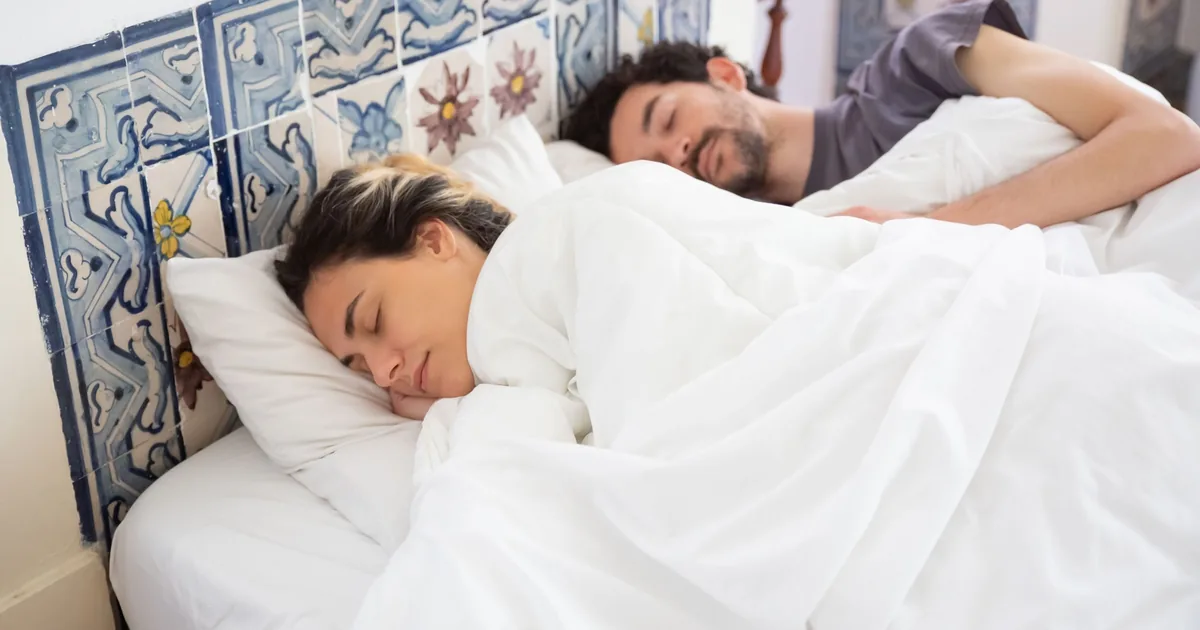
Two clear plastic appliances, both worn at night, both made from a scan of your teeth. One friend wears one because she grinds her teeth. Another wears one because he snores. So when the dentist mentions an appliance, it is natural to wonder: is this the same thing, and which one do I actually need?
The short answer is reassuring: they do different jobs, and the right choice usually becomes clear once you know your main problem. A night guard, also called an occlusal splint, covers the biting surfaces and protects the teeth from grinding and clenching. A snoring mouthpiece, or mandibular advancement device (MAD), holds the lower jaw slightly forward so the airway stays more open during sleep. Sleep medicine and dental sleep medicine groups recommend that a physician decides on snoring or sleep apnea treatment first, and that a qualified dentist then makes and adjusts the device.
This guide puts the two side by side: what each one does, who it suits, what has to be checked first, the general steps, early side effects and daily cleaning. It also sorts out the look-alike appliances people mix up, such as sports mouthguards, retainers, clear aligners and whitening trays, answers whether one person can need both, and compares ready-made products with custom-made ones.
In short: grinding, clenching, worn or chipped teeth and a tired jaw in the morning point to a night guard, starting with a dental examination. Loud snoring, pauses in breathing or daytime sleepiness point to a sleep assessment by a physician first, then a MAD if it is recommended. The two are not interchangeable. If you both snore and grind, tell your dentist about both so the plan covers each problem.
Scope of this article: it helps you choose between the two appliances. For the causes and signs of grinding, read the teeth grinding guide. For how a MAD is built and adjusted, read the MAD device guide. For sleep tests and every treatment option for snoring and sleep apnea, read the MAD for snoring guide.
Teeth grinding (bruxism): causes, signs and treatment
Mandibular advancement device (MAD): what it is and what to expect
MAD for snoring: how the mouthpiece helps snoring and sleep apnea
Night guard and MAD side by side
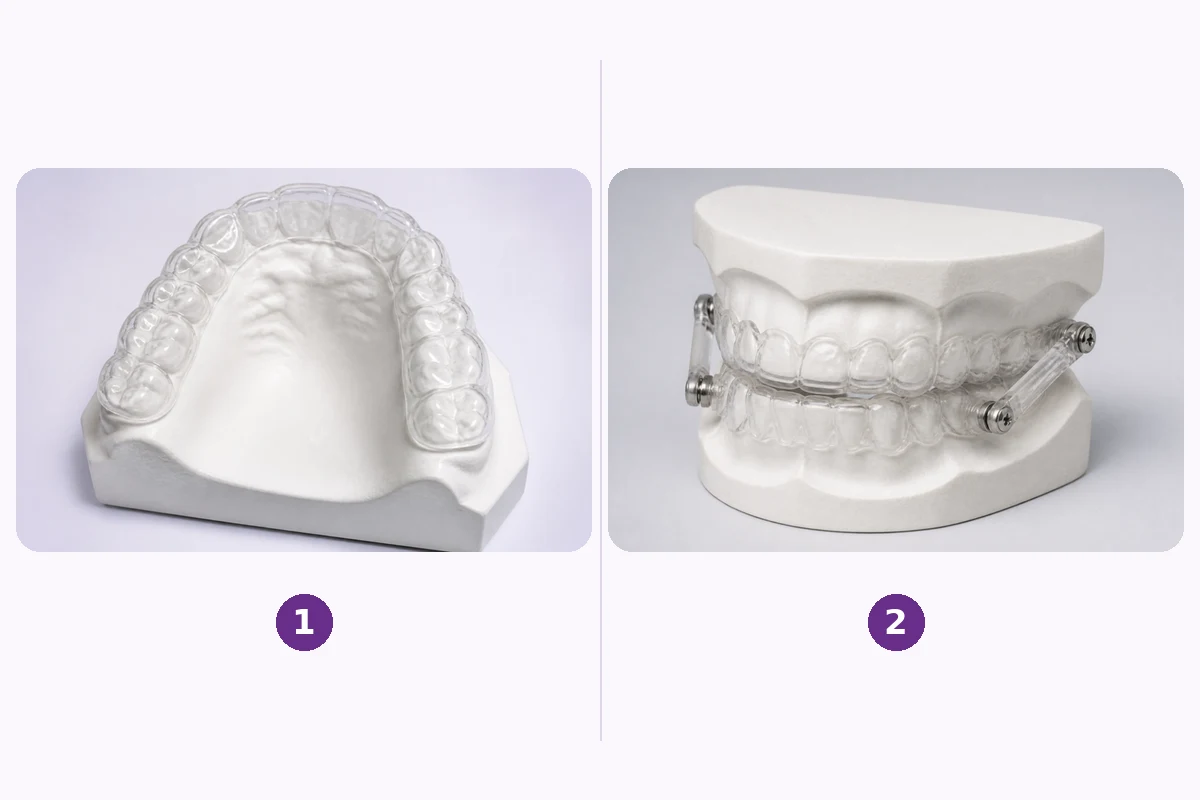
Both appliances look similar on a shelf, so this table compares what matters when you choose. The steps and the number of visits depend on each case, and your dentist plans them with you.
| Question | Night guard (splint) | Snoring appliance (MAD) |
|---|---|---|
| Main job | Protects the teeth from grinding and clenching and lets the jaw muscles rest | Holds the lower jaw slightly forward to help keep the airway open during sleep |
| Who it is for | People who grind or clench, have worn or chipped teeth, or want to protect crowns, veneers and implants | People with snoring or sleep apnea for whom a physician recommends an oral appliance |
| What is checked first | A dental examination of tooth wear, jaw joints and chewing muscles | A sleep assessment by a physician, then a dental check of teeth, gums and jaw joints |
| Shape | Usually one piece over the upper or lower teeth; the jaw stays in its normal position | Covers both upper and lower teeth and links them so the lower jaw sits forward |
| How the steps usually go | Examination, a scan or impressions, then fitting with the bite adjusted and checks as needed; the number of visits depends on your case | A sleep assessment by a physician first, then a dental examination, a scan or impressions, fitting and step-by-step adjustment; the number of visits depends on your case |
| Early side effects | More saliva for the first few days | Brief morning tightness in the jaw or teeth, more saliva or a dry mouth |
| Long-term follow-up | Bring it to every check-up so the bite on the guard can be checked and adjusted | Regular checks of the bite, the fit and the effect on sleep, with the physician |
What a night guard can and cannot do
Bruxism is now described as repeated jaw muscle activity, clenching or grinding the teeth or bracing the jaw, which can happen during sleep or while awake. An international expert consensus treats it as a behavior that can raise the risk of problems for some people, not automatically as a disease. That is why the goal of a night guard is practical: to take the grinding forces on a hard surface instead of on your teeth and dental work.
A systematic review of randomized trials found too little evidence that a splint stops sleep bruxism itself, but noted it may help with tooth wear. In other words, think of a night guard as protection. The habit may continue, so your dentist may also suggest noticing and relaxing daytime clenching. A night guard can also help protect dental work such as crowns, veneers and crowns on implants from grinding forces.
Hard or soft? Night guards come in several designs and materials, and your dentist chooses the one that suits your case. One small, older laboratory study of ten people compared the two: a hard splint reduced night-time muscle activity in eight of them, while a soft splint reduced it in only one and increased it in five. It is a single small study, so it guides rather than decides the choice.
Teeth grinding and night guards
What a snoring mouthpiece (MAD) does
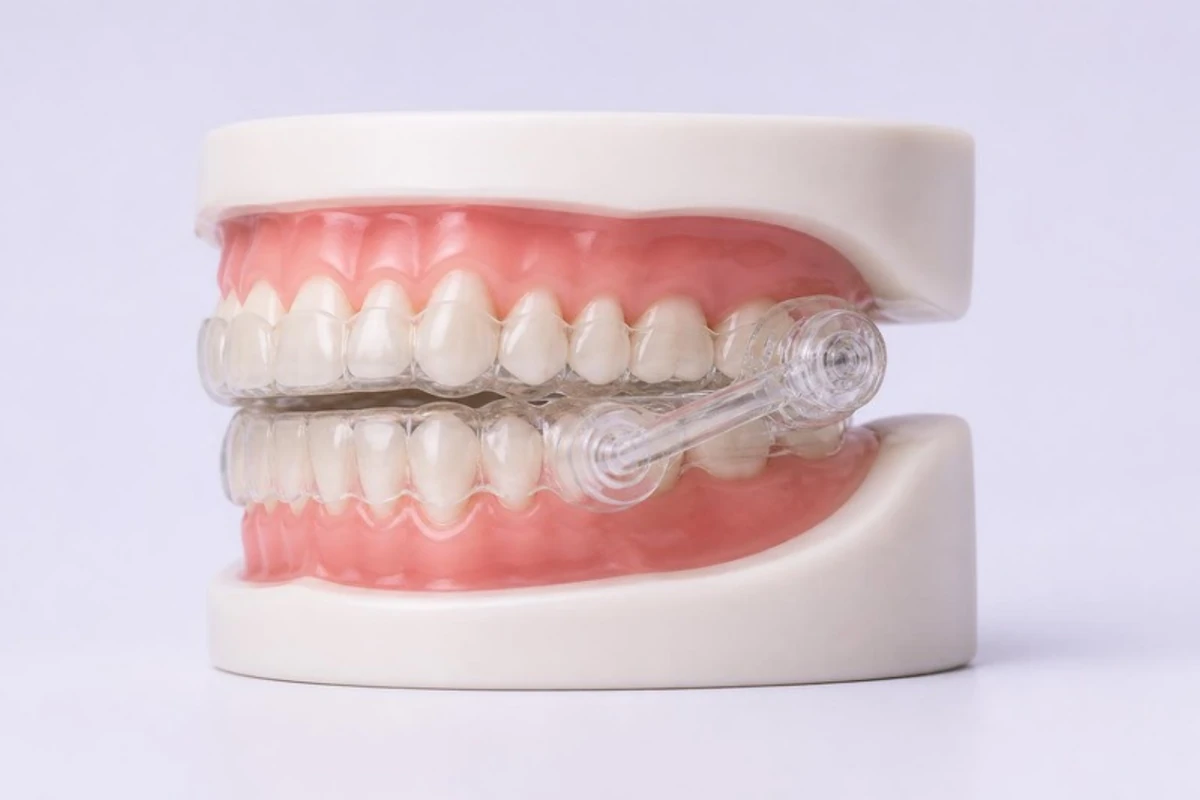
A MAD fits over the upper and lower teeth like two linked trays. By holding the lower jaw a little forward during sleep, it supports the tongue and soft tissues so the airway behind them stays more open. The American Academy of Dental Sleep Medicine describes it as a treatment option for snoring and obstructive sleep apnea, worn while you sleep and adjusted by a dentist over time.
The 2015 joint guideline of the American Academy of Sleep Medicine and the AADSM recommends that a sleep physician prescribes the appliance, for primary snoring or for sleep apnea when a person cannot use or does not want CPAP, and that a qualified dentist uses a custom, adjustable device and follows the patient up. When a sleep test is needed, the clinic refers you to a hospital for a sleep test and coordinates your care.
Snoring and sleep apnea appliance (MAD)
Which group are you in?
Tick what sounds like you. The lists follow the NHS advice pages on teeth grinding and on snoring. This is not a diagnosis, but it shows where to start.
Signs that point to a night guard
- Your partner hears you grinding your teeth at night
- You wake with an aching jaw, face or temples
- Your teeth look flatter, shorter or chipped, or they feel sensitive
- Fillings, crowns or veneers keep chipping
Signs that point to a sleep assessment first
- Loud snoring most nights
- Someone notices your breathing stop and start, or you gasp or choke in your sleep
- You feel sleepy during the day even after a full night in bed
- Snoring is having a big effect on your sleep or on your partner
Ticks in both lists
This is common: the NHS lists snoring and sleep apnea among the sleep problems linked with teeth grinding. Mention both at your appointment. The sleep assessment comes first, and your dentist then explains which appliance suits you.
Look-alike appliances people mix up
Many clear appliances sit over the teeth, but each one is made for a single job. Using one in place of another can mean the real problem is not treated. This table sorts out the six that people confuse most.
| Type of appliance | What it is for | When it is worn |
|---|---|---|
| Night guard (occlusal splint) | Protects teeth from grinding and clenching | Usually while sleeping, and at times you tend to clench |
| Snoring mouthpiece (MAD) | Holds the lower jaw forward to help breathing in sleep | While sleeping, after a physician assessment |
| Sports mouthguard for contact sports | Cushions blows to the face and mouth in contact sports | During training and matches |
| Retainer after braces | Stops teeth moving back after braces | As your orthodontist advises |
| Clear aligners | A series of trays that gradually move the teeth | For most of the day, as your dentist advises |
| Whitening tray | Holds whitening gel against the teeth | For set periods over a course of a few weeks |
A few details help keep them apart. The American Dental Association describes three kinds of sports mouthguard, stock, boil-and-bite and custom-made by a dentist, all designed to cushion impacts. At the clinic, a custom sports mouthguard takes two visits, one to record the teeth and one to collect and try it in, and is ready in 3 working days. The NHS describes whitening trays as made to fit closely around the teeth, like a mouthguard, worn at home for around 2 to 6 weeks, and a retainer as a device that stops teeth moving back after braces.
So a sports mouthguard is for impacts, a retainer and clear aligners are for tooth position, and a whitening tray is for gel. None of them is designed to protect against night grinding or to treat snoring. If you already wear one of these and also grind or snore, tell your dentist so the plan fits all your needs.
Sports mouthguards for Muay Thai: custom-made or ready-made?
Retainers after braces: how long to wear them
Will a night guard help snoring?
A night guard is not a snoring treatment. It keeps the jaw where it normally sits, while a MAD moves it forward. Small sleep laboratory studies have looked at people with sleep apnea who wore a flat upper splint. In one pilot study of ten people, the average apnea index did not change significantly, but it rose by more than half in five people and snoring time increased. A later randomized trial in ten people found a small rise in the average, about 1.4 events per hour, which the authors judged of limited clinical importance.
The practical message is simple: if you snore, or someone has noticed pauses in your breathing, tell your dentist before a night guard is made. The researchers themselves suggest that dentists ask about snoring and sleep apnea when recommending a splint. Your dentist can then plan with you, and a sleep assessment by a physician may come first.
Snoring and grinding: can you need both?
Some people have both problems. Research has looked at whether a MAD alone can also calm grinding. In a short controlled study of thirteen people who ground their teeth heavily, a temporary MAD reduced grinding activity in the sleep laboratory, more than a standard upper splint did. However, eight of the thirteen reported pain in the gums or front teeth with the advanced MAD, and the study lasted only a few nights.
So the evidence is not enough to say that one appliance does both jobs for everyone. In practice, the order matters: the snoring is assessed by a physician first, because sleep apnea needs a medical diagnosis. Your dentist then looks at your teeth, jaw joints and grinding, and explains which appliance suits you, or whether a combination of care is needed. This is decided case by case.
Ready-made or custom-made?
Ready-made products are sold for both grinding and snoring, often as boil-and-bite trays. The evidence is different for each appliance, so it helps to look at them separately.
Night guards
The NHS describes mouth guards and splints for grinding as made by a dentist to fit precisely over the upper or lower teeth. A custom guard is shaped from your own teeth and adjusted to your bite, and it covers the teeth you grind on. If you are thinking about a ready-made guard, your dentist can look at your teeth and bite and explain whether it would suit your mouth, or whether a custom one fits your plan better. If you choose a soft product, keep in mind the small study above in which soft splints did not reduce muscle activity for most people.
Snoring mouthpieces
For a MAD, a randomized trial found that a custom-made device worked better and stayed in place better than a boil-and-bite one, and the AASM and AADSM guideline suggests a custom, adjustable appliance. The details are in the MAD device guide.
Mandibular advancement device (MAD): what it is and what to expect
General steps for each appliance
The lists below show the usual order of care. How many visits you need and how long it takes depend on your case, and your dentist plans this with you.
For a night guard
- History: when you grind or clench, how you feel on waking and what others hear
- Examination of the chewing muscles, jaw joints and tooth wear, with X-rays when needed
- A treatment plan: whether a night guard suits you and what you can do yourself
- A scan or impressions to make the guard
- Fitting, with the bite adjusted on the guard
- Further adjustment when needed, and a check of the guard at your regular visits
Snoring mouthpiece (MAD)
- Sleep assessment: the clinic refers you to a hospital for a sleep test and coordinates your care; if you already have a sleep report, bring it, and the physician and dentist assess whether it can be used
- Dental examination of teeth, gums and jaw joints, with X-rays when needed
- A scan or impressions and a record of the forward jaw position
- Fitting, learning how to wear and clean it, then step-by-step adjustment over time
- Follow-up: the dentist checks the fit and bite, and the physician reviews the effect on sleep
If you are visiting from abroad, mention your travel dates and any sleep report you already have when you book. Your dentist explains what can be planned within your stay, because the number of visits depends on your case. Explanations can be repeated, or sent to you in writing by email or WhatsApp.
Questions that help you understand your plan
You do not need to remember every term. Asking about the things that help you understand your own plan is enough, for example:
- Do my teeth, gums and jaw joints suit this appliance?
- Is anything needed first, such as a sleep test or dental treatment, and does it change the timing?
- What other options do I have?
- Do my health conditions or the medicines I take make a difference?
- How many visits will I need, and how should I plan my travel?
- How do I care for it, and what follow-up does it need in the long term?
Your dentist answers these for your own case. For costs, the prices page lists each item.
Daily care and the first weeks
The two appliances are cared for in slightly different ways, so follow the instructions given for the one you have. The points below are general care advice.
| Question | Night guard (splint) | Snoring appliance (MAD) |
|---|---|---|
| Everyday cleaning | Every time you take it out, brush inside and out with a toothbrush and a little water, then rinse | Every morning, with a soft brush and mild soap, or cleaning tablets your dentist recommends |
| Deeper clean | Once a week, soak in a denture cleaning tablet; mouthwash may stain the guard | As your dentist advises for your device |
| How to store it | In a closed case kept slightly moist, away from children and pets; use room-temperature water because heat can warp it | In a clean, dry case once removed |
| In the first days | More saliva, usually settling within a few days | A few nights to get used to it; brief morning tightness, more saliva or a dry mouth |
| Over time | The biting surface wears and needs checking; heavy grinders may need a new guard sooner | The bite can slowly change, so the dentist checks it at regular follow-ups |
Research on long-term MAD use reports mainly gradual changes in how the front teeth meet, which is why follow-up visits matter.
Myths and facts about night appliances
| Myth | Fact |
|---|---|
| A night guard and a snoring mouthpiece are the same thing. | They look alike but do different jobs: one protects the teeth, the other moves the lower jaw forward to help breathing. |
| Once I wear a night guard, I will stop grinding. | The guard protects the teeth; the habit may continue, so other self-care may be suggested as well. |
| For snoring, any mouthpiece from the internet will do. | Snoring can come with sleep apnea, which a physician should assess, and custom devices worked better than boil-and-bite ones in research. |
| A sports mouthguard works as a night guard. | Sports guards are designed to cushion impacts; your dentist can explain which appliance suits night grinding in your case. |
| A soft guard is gentler, so it must be better. | In one small study soft splints often increased muscle activity; your dentist chooses the material for your case. |
| A retainer at night also protects against grinding. | A retainer is made to hold the teeth in place after braces; tell your dentist if you grind so it can be planned for. |
When to book a check
None of these is an emergency, but each is a good reason to book an appointment rather than wait.
- You grind your teeth and have tooth damage, sensitive teeth, or pain in the jaw, face or ear: see a dentist
- Your breathing stops and starts in sleep, you gasp or choke, or you are sleepy in the day: see a physician
- You already wear a MAD and your jaw aches or your bite feels different: tell your dentist soon
- Your night guard feels loose, tight, cracked or worn through: bring it in to be checked
- Your jaw clicks, locks or will not open fully: have it examined
Jaw clicking or locking: causes and care
If this sounds like you: where to start
These are example situations, not patient stories, to help you find the next step that fits.
- You wake with a tired jaw and your teeth look worn, but nobody hears you snore: book a dental examination to see whether a night guard suits you.
- You snore loudly, your partner has seen you stop breathing and you doze off in meetings: start with a sleep assessment by a physician, then a MAD if it is recommended.
- You snore and grind: mention both, have the sleep assessment first, and your dentist explains which appliance suits you.
- You already have a night guard and have just been told you snore heavily: tell your dentist and see a physician about your sleep, so your care can be reviewed together.
- You train in Muay Thai and also grind at night: a sports mouthguard is for training and a night guard is for sleep; your dentist can plan both.
- You have just finished braces and grind your teeth: tell your dentist, who can plan how your retainer and grinding are managed.
- You are visiting from abroad and already have a sleep report: send it ahead with your travel dates, and your dentist explains what can be planned within your stay.
Frequently asked questions
Can a night guard and a snoring mouthpiece be used in place of each other?
No. A night guard keeps the jaw in its normal position to protect the teeth, while a MAD moves the lower jaw forward to help breathing. Your dentist chooses the appliance that matches your main problem.
Will a night guard stop my snoring?
It is not designed to. Small studies in people with sleep apnea found that a flat splint did not help breathing and was linked with worse results for some. If you snore, tell your dentist before a guard is made.
Does a MAD also help with teeth grinding?
A short study found less grinding activity with a MAD, but many people had gum or tooth pain, and the evidence is limited. If you have both problems, your dentist assesses your case and explains the options.
Do I need a sleep test before a MAD?
Yes, a physician assesses your sleep first, because sleep apnea is diagnosed by a physician. The clinic refers you to a hospital for a sleep test and coordinates your care. If you already have a sleep report, bring it, and the physician and dentist assess whether it can be used.
Can I buy a night guard myself instead?
Your dentist can help you decide. A guard made from your own teeth is adjusted to your bite and covers the teeth you grind on, and your dentist can explain whether a ready-made one would suit your mouth and your plan.
Is it normal to have more saliva or a sore jaw at first?
Extra saliva in the first days is common with both. With a MAD, brief morning tightness is also common. If discomfort continues, or your bite feels different, let your dentist know.
How many visits does each one take?
It depends on your case. A night guard involves an examination, a scan or impressions, and fitting with the bite adjusted. A MAD starts with a sleep assessment by a physician, then dental visits for the examination, fitting and step-by-step adjustment. Your dentist tells you how many visits your plan needs, and if you are traveling, share your dates when you book.
How much does each one cost?
Prices for night guards and snoring appliances are on the prices page. Your dentist confirms which item you need after the examination.
See snoring appliance and night guard prices
Summary
Choose by your main problem: grinding points to a night guard after a dental examination, and snoring or sleep apnea points to a MAD after a physician assessment.
- A night guard protects the teeth from grinding; a MAD holds the lower jaw forward to help breathing.
- A night guard is not a snoring treatment, so mention snoring before one is made.
- Sports mouthguards, retainers, clear aligners and whitening trays each have a different job.
- For a MAD, custom-made devices worked better than boil-and-bite ones in research.
- Clean the appliance every day, store it as advised and bring it to every check-up.
References
American Academy of Dental Sleep Medicine. Oral appliance therapy
Okeson JP. The effects of hard and soft occlusal splints on nocturnal bruxism. J Am Dent Assoc 1987
NHS. Bruxism and teeth grinding