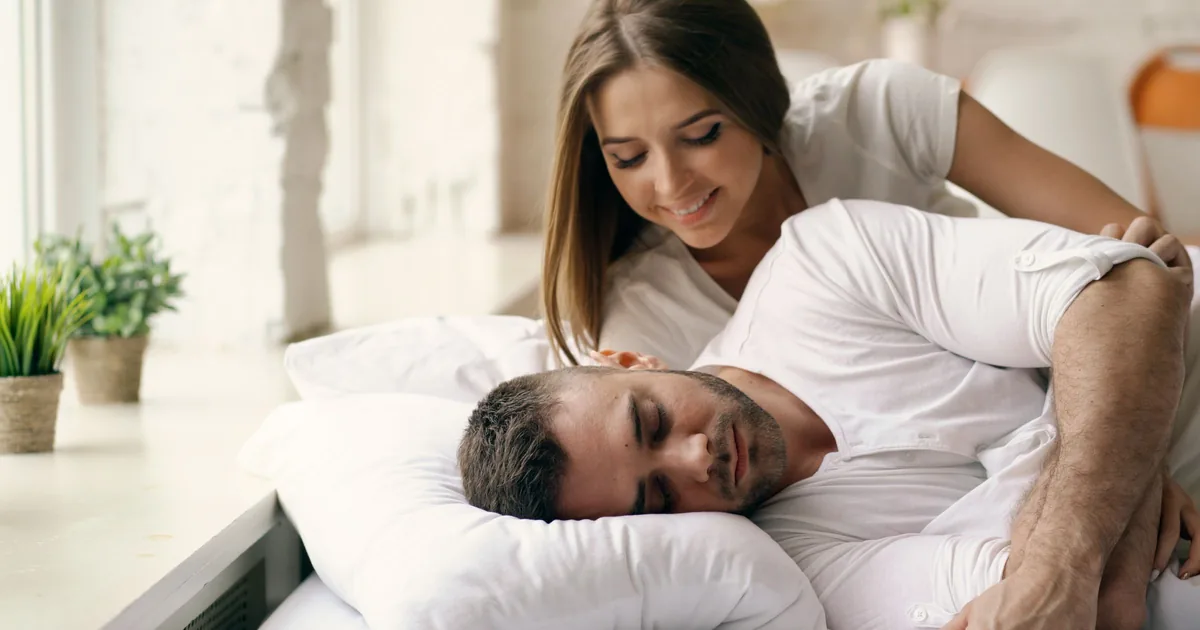
Maybe your partner has started sleeping in another room. Maybe you wake up tired even after a full night in bed. And you may have read that a mouthpiece called a MAD can stop snoring, and wondered whether it would work for you.
The reassuring part is that snoring is common and usually not serious, and there are several proven ways to help. For people who need treatment, a custom MAD made and adjusted by a dentist is one of the options recommended in a joint guideline of the American Academy of Sleep Medicine and the American Academy of Dental Sleep Medicine. The key is knowing first whether you simply snore, or whether the snoring comes with obstructive sleep apnea.
This article walks you through the whole path: how to tell simple snoring from sleep apnea, why a sleep test comes first, what the test result means, how a MAD compares with CPAP and other treatments, who a MAD suits, and what happens from the first test to follow-up, including if you already have a sleep test report from home or abroad.
In short: a MAD can reduce snoring and the breathing pauses of sleep apnea by holding the lower jaw slightly forward during sleep. Because snoring can come with sleep apnea, the path starts with a sleep test that a physician reads. A dentist then checks whether your teeth, gums and jaw joints suit a custom appliance, adjusts it step by step, and your physician checks the result.
What this article covers: the path from snoring to the right treatment. For the appliance itself, its parts, how it is made, adjusted and cleaned, and its side effects, read our article on the mandibular advancement device. For the difference between a MAD and a night guard for teeth grinding, read our comparison article.
Mandibular advancement device (MAD): what it is and what to expect
Night guard or snoring appliance (MAD): what is the difference?
Snoring or sleep apnea?
Snoring is the sound of air passing relaxed, narrowed tissues in the mouth, nose and throat during sleep, which makes them vibrate. The NHS lists being overweight, smoking, drinking heavily and sleeping on your back as things that raise the chance of snoring.
In obstructive sleep apnea (OSA), the airway narrows or closes again and again during sleep, so breathing stops and starts. It is common: a 2019 analysis in The Lancet Respiratory Medicine estimated that about 936 million adults aged 30 to 69 worldwide have OSA, and about 425 million of them have moderate to severe OSA. Many people do not know they have it, because the signs happen while they are asleep.
Signs that point beyond simple snoring, based on the NHS:
- Breathing that stops and starts during sleep, often with gasping, snorting or choking sounds.
- Loud snoring, and waking up often during the night.
- Feeling very tired during the day, finding it hard to concentrate, or having mood changes.
- Headaches when you wake up.
These signs are hard to notice in yourself. A bed partner, or anyone who stays with you overnight, can watch for them, and the NHS suggests bringing that person to your appointment to describe what they saw.
Which group are you in?
This checklist helps you plan the next step. It is not a diagnosis, because only a sleep test can tell whether you have sleep apnea and how severe it is.
| Your group | What you notice | A sensible next step |
|---|---|---|
| Snoring only | Snoring that is quieter on your side or after no alcohol, with no breathing pauses seen and no daytime sleepiness. | Try the self-care steps in this article. If snoring still bothers you or your partner, see a physician. |
| Worth a check | Loud snoring most nights, waking unrefreshed or with a dry mouth or headache, or high blood pressure. | See a physician, who decides whether you need a sleep test. |
| See a physician soon | Someone has seen you stop breathing or gasp, or you feel sleepy while driving or at work. | Book a physician visit soon, and avoid driving when you feel sleepy until you have been assessed. |
Screening questionnaires
Physicians often use short questionnaires to judge the risk. One common screening questionnaire has eight yes or no items about snoring, tiredness, observed breathing pauses, blood pressure, body mass index, age, neck size and sex. In a review by its developers, a score of 0 to 2 was classed as low risk and 5 to 8 as high risk for moderate to severe OSA. Another tool scores how likely you are to doze off in eight everyday situations, such as reading or sitting as a car passenger.
These tools are useful for starting the conversation, but the American Academy of Sleep Medicine recommends that questionnaires and prediction tools are not used on their own to diagnose OSA in adults. A sleep test is still needed.
Want to see where you stand? You can answer the eight STOP-Bang questions on our website. It takes about a minute, the result shows whether your score is in the low, intermediate or high-risk range, and your answers stay on your device. Use it to start the conversation with a doctor, not as a diagnosis.
Why a sleep test comes first
A MAD can quiet the snoring while sleep apnea continues underneath. That is why the path starts with a sleep test: it shows whether your snoring comes with sleep apnea, and how severe it is. The result decides which treatments make sense, and gives a baseline to compare against once treatment starts.
Types of sleep test
- Overnight sleep study in a sleep laboratory (polysomnography): sensors record breathing, oxygen level, heart rate, brain waves and body position. It is the standard test for diagnosing OSA.
- Home sleep apnea test: a smaller set of sensors you wear at home. Guidelines support it for adults without other major health problems whose signs suggest moderate to severe OSA.
- If a home test is negative, unclear or not technically adequate, the guideline recommends a full sleep study in a laboratory.
Which test you have is the physician decision. The NHS notes that most people can do the test at home, while some need to stay overnight.
How the clinic helps with the sleep test
The clinic refers you to a hospital for the sleep test and coordinates your care. If you have already had a sleep test elsewhere, in your home country or abroad, you can send the full report. Your physician and dentist look at it and tell you whether it can be used to plan your treatment, or whether a new test would help.
What the AHI result means
The main number on a sleep test report is the apnea-hypopnea index (AHI): the average number of times per hour of sleep that breathing stops or becomes very shallow. The NHS groups the result as follows.
| Severity | AHI (events per hour of sleep) | What it usually means for the next step |
|---|---|---|
| Simple snoring | Below the mild range | Snoring without sleep apnea. A MAD and self-care can help if the snoring bothers you. |
| Mild | 5 to 14 | Your physician discusses the options, which often include a MAD, weight and lifestyle changes and sleep position. |
| Moderate | 15 to 30 | CPAP and a MAD are both discussed. Your physician weighs the result, your symptoms and what you can use every night. |
| Severe | More than 30 | CPAP is usually discussed first. A MAD is an option if you cannot use CPAP or prefer another treatment, with follow-up testing. |
Reports also show other figures, such as the lowest oxygen level and how much worse breathing is on your back. Your physician reads these together, so it is worth bringing the full report, not only the summary page.
Treatment options compared
There is no single treatment that suits everyone. Your physician matches the treatment to your test result, your symptoms, the shape of your airway and what you can comfortably keep using. This table summarizes the main options.
| Option | How it helps | Good to know |
|---|---|---|
| CPAP machine | A mask over the nose, or nose and mouth, gently delivers air to keep the airway open. | In trials it lowers the AHI more than a MAD or position therapy. Works only when worn every night. |
| MAD (oral appliance) | A custom mouthpiece holds the lower jaw slightly forward during sleep. | Quiet, small and easy to travel with. Needs healthy teeth and gums, step-by-step adjustment and follow-up. |
| Weight and lifestyle | Losing excess weight, stopping smoking and drinking less alcohol. | Helps on its own in some people and adds to any other treatment. |
| Sleep position | Sleeping on your side, helped by a pillow or a small device that discourages lying on your back. | Suits people whose breathing is mainly worse on their back. |
| Surgery by a physician | Operations on the nose, throat or jaws, or weight-loss surgery, done in hospital. | Usually discussed when CPAP cannot be used or is not accepted. One example is removing large tonsils. |
MAD or CPAP?
CPAP is very effective. An American Academy of Sleep Medicine review found that, compared with no treatment, it reduces sleep apnea severity, sleepiness, blood pressure and car accidents, and improves sleep-related quality of life. The challenge is wearing a mask every night.
In a 2013 randomized trial of 126 people with moderate to severe OSA, each person used both treatments for a month. CPAP lowered the AHI further, to an average of 4.5 per hour against 11.1 with the MAD, but people wore the MAD longer, about 6.5 hours a night against 5.2 hours for CPAP. Sleepiness, driving simulator performance and quality of life improved by similar amounts with both. A Cochrane review reached a similar picture: oral appliances lower the AHI less than CPAP, but symptom scores did not differ significantly, and in two small studies people preferred the appliance.
In other words, the better treatment is often the one you will actually use every night, and your physician helps you weigh effect against comfort.
Weight, alcohol and sleeping on your side
Weight is linked to how severe sleep apnea is. In a study that followed 690 adults for four years, a 10 percent weight loss was associated with about a 26 percent lower AHI, and a 10 percent weight gain with about a 32 percent higher AHI. The NHS also suggests stopping smoking, drinking less alcohol, and avoiding sleeping pills where possible; talk to your doctor before changing any medicine.
Some people snore and stop breathing mainly on their back. A Cochrane review found that positional therapy, such as a vibrating position alarm or a special pillow, improved daytime sleepiness and the AHI compared with no positional therapy, although CPAP lowered the AHI more. The studies were short, so the long-term effect is less certain.
When surgery is discussed
An American Academy of Sleep Medicine guideline recommends that physicians discuss referral to a sleep surgeon with adults with OSA who cannot tolerate or do not accept CPAP, and discuss weight-loss surgery with those who also have significant obesity. Surgery is done in hospital by surgeons. For simple snoring, the NHS notes that surgery is not always effective and snoring can come back.
Who a MAD suits
The 2015 guideline of the American Academy of Sleep Medicine and the American Academy of Dental Sleep Medicine is the main reference here. It recommends that sleep physicians:
- Prescribe an oral appliance, rather than no therapy, for adults who want treatment for snoring without sleep apnea.
- Consider an oral appliance, rather than no treatment, for adults with OSA who cannot tolerate CPAP or prefer another treatment.
- Use a custom, adjustable appliance made by a qualified dentist, rather than a ready-made device.
- Arrange a follow-up sleep test to confirm the effect, and regular visits with both the dentist and the physician.
In Thailand, a Siriraj Hospital article for the public describes the oral appliance as one option for simple snoring and for mild to moderate sleep apnea, especially for people who prefer it to CPAP or find CPAP uncomfortable, and advises care by a dentist trained in dental sleep medicine with regular check-ups.
From the dental side, the appliance needs enough healthy teeth to hold onto, healthy gums, and jaw joints that are comfortable moving forward. Your dentist checks your teeth, gums and jaw joints and takes X-rays when needed. If you need fillings or gum treatment first, your dentist plans this with you.
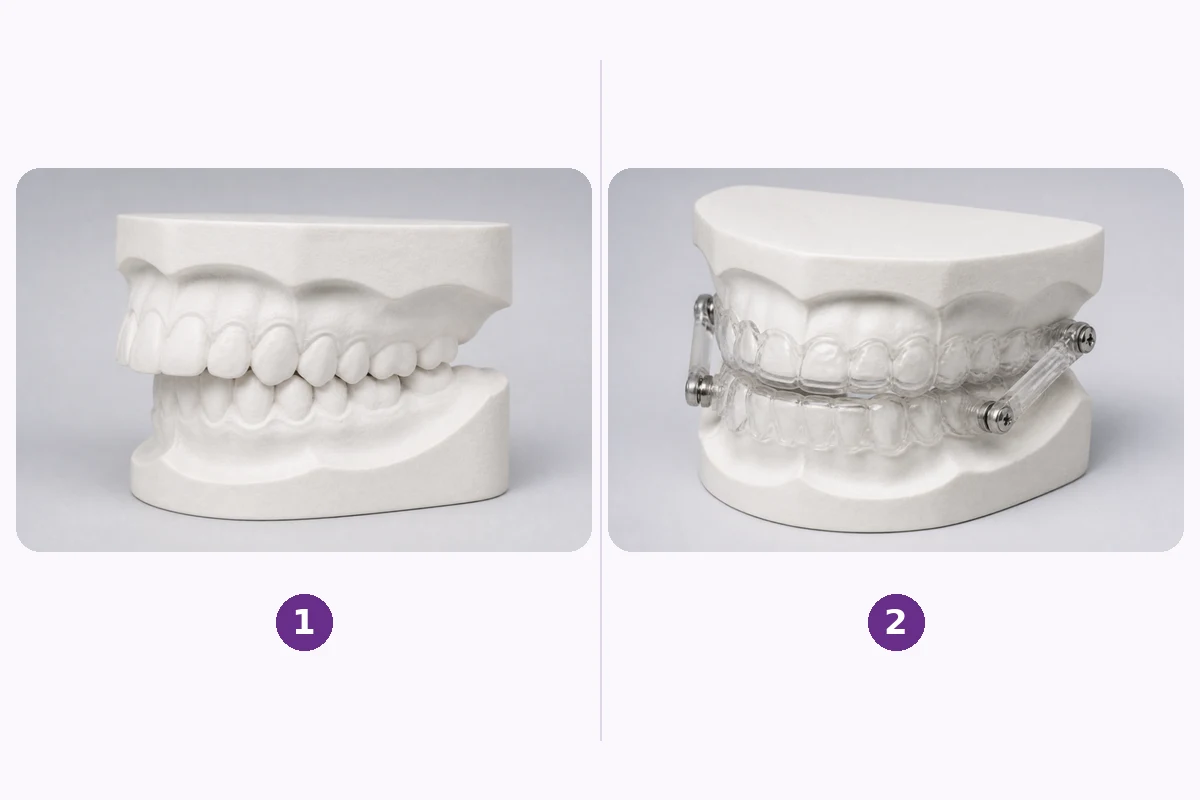
Why moving the jaw forward helps: the tongue is attached to the lower jaw, so when the jaw sits slightly forward, the tongue moves with it and the airway behind the tongue stays more open. The parts of the appliance, how it is made and how it is adjusted are explained in our article on the device.
If you also grind your teeth, a MAD and a night guard are different appliances with different jobs. Your dentist explains which suits you.
Teeth grinding (bruxism): causes, signs and treatment
From sleep test to follow-up
In general, the path runs in this order. The number of visits and the time between steps differ from case to case, and your dentist and physician plan them with you.
- Physician assessment and sleep test: the physician reviews your symptoms and arranges the test, or reviews a recent report you already have.
- Treatment choice: the physician explains the options, including CPAP and a MAD, and which suits your result.
- Dental examination: your dentist checks your teeth, gums and jaw joints, with X-rays when needed.
- Impressions or a digital scan: your dentist records your teeth and a forward jaw position for the appliance.
- Fitting: you receive the appliance and learn how to put it in and clean it.
- Step-by-step adjustment: your dentist moves the jaw position forward a little at a time, at a pace that suits your case.
- Checking the effect: your physician reviews your sleep, often with a follow-up sleep test while wearing the appliance.
- Long-term follow-up: regular visits with your dentist to check the fit, your teeth and your bite, and with your physician for your sleep.
What to expect from a MAD
- Results differ from person to person. For many people snoring becomes quieter and breathing pauses fewer, but the appliance may not bring the AHI fully down. That is why the effect is checked, not assumed.
- The effect builds up during adjustment. The jaw is moved forward in small steps until your physician and dentist agree on the balance between effect and comfort.
- The appliance works only on the nights you wear it, so it needs to fit into your nightly routine.
- Many people need a few nights to get used to it. Morning tightness in the jaw or teeth, extra saliva or a dry mouth are common at first; tell your dentist about anything that persists.
- Over the years the way your teeth meet can gradually change, so long-term dental check-ups are part of the treatment.
Side effects, cleaning and how long an appliance lasts are covered in detail in our article on the device. Your dentist assesses each case.
Already have a sleep test report, or visiting from abroad?
Many people who come to Chiang Mai have already had a sleep test in their own country. You can send that report, from another hospital in Thailand or from abroad, before you travel. Your physician and dentist assess whether it can be used to plan your treatment or whether a new test would help, so you know what to expect before you arrive.
- Send the full sleep test report, including the AHI, oxygen levels and the physician summary or recommendation if there is one.
- If you already use CPAP or an appliance, say so, and bring the appliance with you.
- Share your travel dates with the clinic. The number of visits and how long the appliance takes depend on your case, and your dentist plans them with you.
- Chinese-speaking patients can contact the clinic on LINE, where a Chinese-speaking coordinator can help. Explanations can be repeated, or sent in writing by email or WhatsApp.
You do not need to remember every medical term. Before you fly home, a few questions like these help you understand your own plan:
- Do my teeth, gums and jaw joints suit a MAD, or is there anything to take care of first?
- How will further adjustment and follow-up work for me once I am back home?
- What should I do if my jaw or teeth feel sore, or the appliance feels loose?
- How do I look after the appliance and my teeth in the long term?
Your dentist answers these for your own case. It also helps to involve your physician at home early, because a follow-up sleep test may take place where you live.
Planning treatment from abroad
Myths and facts about snoring
| Myth | Fact |
|---|---|
| Loud snoring means deep, good sleep. | Snoring is air passing narrowed tissues. With sleep apnea, breathing pauses and frequent waking break up sleep. |
| A questionnaire or an app can tell me whether I have sleep apnea. | Questionnaires help judge the risk, but diagnosis needs a sleep test read by a physician. |
| If the snoring stops, the sleep apnea is gone too. | Breathing pauses can continue more quietly. A follow-up sleep test confirms the effect. |
| A mouthpiece bought online works the same as a custom one. | For sleep apnea, the joint guideline suggests a custom, adjustable appliance made by a qualified dentist over ready-made devices. |
| CPAP is the only real treatment. | CPAP lowers the AHI more, but in a one-month trial a MAD gave similar health improvements. The researchers suggest this is because people wore the MAD longer. |
| Snoring only matters if you are overweight. | Weight is one factor. Alcohol, smoking, sleeping on your back and the shape of the airway also play a part. |
When to see a physician
Snoring alone is rarely urgent, but it is worth booking a physician visit, without panic, if any of these apply:
- Someone has seen you stop breathing, gasp or choke during sleep.
- You feel sleepy during the day even after enough hours in bed, or doze off at the wheel.
- You have high blood pressure, heart disease or diabetes as well as loud snoring; the NHS notes that untreated sleep apnea is linked with these conditions.
- Lifestyle changes have not helped, or snoring is affecting your life or your partner.
If you are very sleepy, the NHS advises not driving until the tiredness is under control. A physician can assess you and plan treatment, and many people feel more alert once their sleep apnea is treated.
If this sounds like you
These are example situations, not patient stories, to help you find the next step that fits.
- You snore loudly, your partner has seen pauses in your breathing, and you feel sleepy at work: start with a physician and a sleep test before choosing any device.
- Your sleep test showed snoring without sleep apnea, but the noise still bothers your partner: a custom MAD is one option, together with side sleeping and drinking less alcohol, and your dentist checks whether your teeth and jaw suit it.
- You have OSA and tried CPAP, but cannot sleep with the mask: talk with your physician about a MAD, then have a dental examination.
- You use CPAP well at home but travel often: a MAD may serve as a travel option alongside CPAP for some people, and your physician can plan this with you.
- You have a sleep test report from abroad and a short holiday in Chiang Mai: send the report and your travel dates first, so your physician and dentist can assess the report and plan with you what fits your stay.
- Your snoring is much worse on your back: tell your physician, because sleep position may be part of your plan.
- You have loose teeth or gum problems and want a MAD: your dentist treats the teeth and gums first, then plans the appliance.
How the clinic can help
This is the general order. Each case is different, so your dentist plans the details with you.
- You tell the clinic about your snoring and send any sleep test report you already have.
- If you need a sleep test, the clinic refers you to a hospital for the sleep test and coordinates your care.
- Your dentist examines your teeth, gums and jaw joints, and takes X-rays when needed.
- A record of your teeth and of the forward jaw position is taken for making the appliance.
- You receive the appliance, and the jaw position is then adjusted forward step by step.
- Your dentist follows up on the fit, your teeth and your bite, and your physician reviews the effect on your sleep.
The number of visits and the time between them depend on your case. The clinic is open every day from 09:00 to 20:00, and fees are on the prices page.
See snoring appliance and night guard prices
Snoring and sleep apnea appliance (MAD)
Frequently asked questions about MAD for snoring
Does a MAD really stop snoring?
It can reduce snoring for many people, and the joint guideline recommends it for adults who want treatment for snoring without sleep apnea. How much it helps differs from person to person, which is why it is adjusted step by step and the result is checked.
Can I get a MAD without a sleep test?
A sleep test comes first, because a MAD can quiet snoring while sleep apnea continues. The test shows whether you have sleep apnea and how severe it is, so the right treatment can be chosen.
Is a custom MAD different from a boil-and-bite mouthpiece?
A custom MAD is made from your own impressions or scan and can be adjusted in small steps. For sleep apnea, the joint guideline suggests a custom, adjustable appliance made by a qualified dentist over ready-made devices.
Can a MAD replace CPAP?
For some people, yes. The guideline supports a MAD for adults with OSA who cannot tolerate CPAP or prefer another treatment. CPAP lowers the AHI more, so your physician decides based on your result and checks the effect with a follow-up test.
Can I use a MAD together with CPAP?
An oral appliance can be used alone or together with CPAP, according to a Siriraj Hospital article for the public. Whether this suits you is a decision for your physician and dentist together.
My sleep apnea is severe. Can I still use a MAD?
CPAP is usually discussed first for severe sleep apnea. If you cannot use CPAP or prefer another treatment, the guideline supports considering a MAD, with a follow-up sleep test to check how well it works for you.
Can I use a sleep test report from another country?
You can send it. Send the full report before you travel, together with your travel dates. Your physician and dentist assess whether it can be used to plan your treatment or whether a new test would help, and your dentist plans the visits with you.
Will losing weight stop my snoring?
It often helps. In a four-year study, a 10 percent weight loss was associated with about a 26 percent lower AHI. Not everyone who snores is overweight, though, so weight loss works well as part of a plan your physician makes with you.
Do I need another sleep test after getting a MAD?
For sleep apnea, the guideline suggests a follow-up sleep test with the appliance to confirm or improve the effect, plus regular visits with your dentist and physician.
Summary
Snoring is common, but it can come with sleep apnea. Start with a physician and a sleep test, then choose the treatment you can use every night. A custom MAD is a well-supported option for simple snoring and for people with OSA who cannot use CPAP or prefer another treatment.
- Breathing pauses, gasping and daytime sleepiness point beyond simple snoring.
- Only a sleep test diagnoses sleep apnea; the AHI shows how severe it is.
- CPAP lowers the AHI most; a MAD is often worn longer, and health benefits can be similar.
- Weight, alcohol and sleep position add to any treatment.
- A MAD needs a dental examination, step-by-step adjustment and follow-up with both your dentist and physician.
References
Lim J, et al. Oral appliances for obstructive sleep apnoea. Cochrane Database Syst Rev 2006
Johns MW. A new method for measuring daytime sleepiness: the Epworth sleepiness scale. Sleep 1991