

Maybe a partner said you make a grinding sound at night. Maybe you wake with a tired jaw or a dull headache, or your dentist pointed out flat, worn edges on your teeth. It is natural to wonder what is going on, whether it is harmful, and how to make it stop.
The reassuring part first. Teeth grinding in sleep is common: in surveys of adults, around 1 in 8 report grinding often. An international group of bruxism researchers concluded in 2018 that in otherwise healthy people it is a behavior, not a disease. It only needs attention when it causes problems, such as worn or broken teeth, sore jaw muscles or disturbed sleep, and those problems can be managed.
This guide explains the two kinds of bruxism, what research links it to, how to check yourself at three levels, what it does to teeth, muscles and the jaw joint, what you can do at home, what is different in children, and how a dentist examines it step by step. Every number comes from a source listed at the end.
In short: bruxism is grinding or clenching the teeth when you are not eating. Sleep bruxism is linked to brief arousals during sleep and to factors such as stress, anxiety, smoking, heavy drinking, caffeine and snoring. Most people do not need to stop it completely; the aim is to protect the teeth and jaw muscles with daily habits and, when needed, a custom splint from a dentist.
What this article covers: the condition itself, its causes and signs. For a side-by-side guide to night guards and snoring appliances, and for snoring and sleep apnea, see the two related articles below.
Night guard or snoring appliance (MAD): what is the difference?
MAD for snoring: how the mouthpiece helps snoring and sleep apnea
What is bruxism?
Bruxism is repeated activity of the chewing muscles that clenches or grinds the teeth, or braces and pushes the lower jaw, at times when you are not eating. Researchers describe two kinds. Sleep bruxism happens during sleep and can be rhythmic, with grinding sounds, or a steady clench. Awake bruxism happens during the day and is mostly holding the teeth together or bracing the jaw, often without noticing.
Grinding means the teeth slide against each other and often make a sound. Clenching means pressing them together hard, which is silent. That is why some people who clench strongly never hear about it from anyone, yet still have tired jaw muscles or cracked teeth.
| Point to compare | Sleep bruxism | Awake bruxism |
|---|---|---|
| When | During sleep | While awake, often when focused or stressed |
| Typical pattern | Rhythmic grinding or clenching, sometimes with sounds | Holding the teeth together or bracing the jaw, usually silent |
| How people find out | A partner hears it, morning jaw ache, wear seen by a dentist | Catching yourself clenching, tired jaw late in the day |
| What helps most | Protecting the teeth, sleep and lifestyle habits | Noticing the habit and relaxing the jaw |
Many people have both kinds. Because the two need slightly different care, it helps to notice when your symptoms are worse: on waking, which points to sleep, or towards evening, which points to daytime clenching.
How common is teeth grinding?
A systematic review of adult studies found that about 12.8 percent of adults report frequent sleep bruxism, and 22 to 31 percent report awake bruxism. It was found equally in men and women and became less common in older age. The authors warn that most studies relied on questionnaires, so the real figures are uncertain.
A large telephone survey of more than 13,000 teenagers and adults in the United Kingdom, Germany and Italy found that 8.2 percent ground their teeth in sleep at least once a week, and about half of them had a consequence such as morning muscle discomfort or dental work. A Thai dental faculty article on sleep bruxism notes similar levels in Thai studies, and adds that people who sleep alone often do not know they grind.
Why do people grind their teeth?
There is rarely one single cause. Sleep research shows that grinding usually follows a micro-arousal: a few seconds when the brain becomes lighter in sleep, the heart speeds up and muscle tone rises, then the jaw muscles start a rhythmic chewing movement. In a sleep lab study, when researchers triggered these brief arousals with sensory stimuli, people with sleep bruxism showed this jaw activity afterwards, and it included grinding about 71 percent of the time.
Many everyday factors are linked to how often this happens. The table below shows what a large population survey found. These are associations: they make grinding more likely, but they do not prove that one thing causes it.
| Factor | What the research found | What it means for you |
|---|---|---|
| Obstructive sleep apnea | About 1.8 times the odds of reporting sleep bruxism | If you also snore loudly or stop breathing in sleep, tell your dentist |
| Loud snoring | About 1.4 times | Snoring and grinding often travel together |
| Heavy alcohol use | About 1.8 times | Cutting down may help |
| Caffeine | About 1.4 times | Coffee, tea and energy drinks are worth cutting down |
| Smoking | About 1.3 times | Stopping smoking helps the teeth and gums as well |
| A very stressful life or anxiety | About 1.3 times each | Stress management and a regular sleep routine are a good first step |
Two more factors appear in health guidance. Some medicines, including some used for sleep problems, depression or anxiety, are linked to grinding. If you think a medicine plays a part, talk to the doctor who prescribed it rather than stopping it yourself. Grinding also tends to run in families, so it helps to know if a parent or sibling grinds.
What about the bite? Many people assume that uneven teeth are the cause. A Thai dental faculty article explains that the exact cause is still not known, and that current thinking links it to signaling systems in the brain, together with the factors above. Your dentist also checks your bite as part of the examination.
Self-check: which group are you in?
Start with the easy clues. Ask the person you sleep next to whether they have heard grinding. If you sleep alone, look in a mirror: are the tips of your canines or the chewing surfaces of your back teeth flatter than before, without a reason like very hard food? Are there fine crack lines on the front of your teeth? Then match yourself to one of the three groups below.
Group 1: watch and look after yourself
- You sometimes catch yourself clenching, but there is no pain and no change in your teeth.
- Someone heard you grind once or twice during a stressful time.
- Try the home steps in this article and mention it at your next routine check-up.
Group 2: book a dental check
- A partner hears you grinding regularly.
- You often wake with a tired jaw, aching temples or a headache.
- Your teeth look shorter, flatter or chipped, or feel more sensitive to cold.
- Fillings or crowns keep chipping or coming loose.
- Home care has not helped after several weeks.
- You are worried about your child grinding their teeth.
Group 3: see a dentist soon
Pain when eating, a jaw that will not open or close, a broken tooth, or loud snoring with pauses in breathing. See the section on when to see a dentist or a doctor below for who to contact.
What grinding does to teeth, muscles and the jaw joint
Grinding forces repeat night after night and are stronger than normal chewing. Over months and years the effects build up slowly, which is why many people only notice them late. The table shows where the effects appear and what helps each one.
| Part affected | What you may notice | What helps |
|---|---|---|
| Teeth | Worn, flat or shorter teeth, chipped edges, crack lines, sensitivity to cold | Protecting the teeth at night, then repairing worn teeth when needed |
| Fillings, crowns and implants | Chipping, cracking or loosening of restorations | A night guard protects them from grinding forces |
| Jaw muscles | Tired or sore jaw and temples on waking, larger muscles at the angle of the jaw | Warmth or cold packs, gentle massage, soft food for a few days, relaxing the jaw |
| Jaw joint | Pain in front of the ear, clicking, difficulty opening wide | An examination of the joint; care works well when several steps are combined |
| Sleep and head | Morning headaches, earache, a partner disturbed by the noise | Sleep routine, cutting down alcohol and caffeine, checking for snoring |
Very worn teeth can also trap food between them, which makes decay and gum inflammation more likely. Wear that has gone deep may need a larger repair. Looking after it early keeps your natural teeth and any dental work in good shape for longer.
If jaw pain, clicking or a jaw that catches is your main concern, read more about jaw joint care:
Jaw clicking or locking: causes and care
How to stop teeth grinding: what helps

Health guidance is clear that not everyone who grinds needs treatment. When it does cause problems, care usually works in three layers: habits, sleep and stress first; protecting the teeth with a custom splint when needed; and repairing worn or broken teeth once they are protected. A review of sleep bruxism treatments found that oral appliances are the one approach with consistent support. Other approaches showed some promise but not enough evidence to be a standard.
1. Habits, sleep and stress
- Relax before bed with slow breathing, music or a short walk, and exercise regularly.
- Keep a regular bedtime and a dark, quiet bedroom.
- Cut down on alcohol and caffeine, and get help to stop smoking.
- When your jaw is sore, skip chewing gum and very hard or chewy food for a while.
- For sore muscles, use a cold pack wrapped in a towel for 20 to 30 minutes, or warm damp heat, and massage gently.
- If stress or anxiety feels heavy, talking to a doctor is part of looking after your teeth too.
2. Daytime clenching: lips together, teeth apart
At rest, the upper and lower teeth should not touch. They meet mainly when you chew and swallow. A simple rest position used by orofacial pain clinics: rest the tip of your tongue on the roof of the mouth just behind the upper front teeth, as if saying the letter N, keep the teeth slightly apart and the lips lightly together. Learning to notice daytime clenching works better than trying to control grinding in sleep.
- Put small reminders where you clench: the steering wheel, your computer screen, your phone.
- Each time you notice your teeth touching, let the jaw drop slightly and relax your shoulders.
- Your dentist can show you the position and simple jaw stretches.
3. Protecting the teeth with a splint
A night guard or occlusal splint is a custom appliance made by a dentist and usually worn during sleep. It protects the teeth from the forces of grinding and may ease muscle strain. It does not always stop the grinding habit, and symptoms can come back when people stop wearing it, so it works together with the steps above. The choice of splint, how it is made and how to care for it are covered in the night guard article.
Teeth grinding and night guards
4. Repairing worn or broken teeth
Worn or broken teeth can be restored with fillings, onlays or crowns. When many teeth are worn, the repairs are usually planned as a whole so the bite stays comfortable. Which repair suits you, and in what order, depends on your teeth, and your dentist plans it together with you.
Other options, such as medicines or injections into the jaw muscles, are sometimes discussed for severe cases. They are decided case by case with the dentist or doctor, after weighing the possible side effects.
Teeth grinding in children
Grinding is most common in childhood, and many children stop as they reach their teens. Studies of how often it happens in children vary widely, from about 6 to 50 percent, mostly because they measured it in different ways. A Thai dental faculty article summarizes it as more common in children than in adults.
- Grinding sounds alone, in a child who sleeps well and has no pain, are often watched rather than treated.
- Book a dental check if you are worried, if the teeth look worn or the child complains of jaw or tooth pain.
- Loud snoring or pauses in breathing at night are worth mentioning to the dentist and the doctor.
- Children can have their teeth checked from the time the first tooth appears.
Teeth grinding myths and facts
| Myth | Fact |
|---|---|
| Everyone who grinds needs treatment. | In healthy people grinding is a behavior, not a disease. Care is needed when it causes problems such as worn teeth, pain or poor sleep. |
| If nobody hears it, you are not grinding. | Clenching is silent. Worn teeth, crack lines and a tired jaw on waking are clues too. |
| A night guard will cure the grinding. | A splint protects the teeth and may ease the muscles. The habit can continue, and symptoms can return when it is not worn. |
| Grinding is only about stress. | Stress is common, but sleep arousals, snoring, alcohol, caffeine, smoking, some medicines and having family members who grind are also linked. |
| It mostly affects one sex. | Adult studies find it about equally in men and women. |
| A child who grinds has a serious problem. | It is common in childhood and often stops by the teens. A check helps if you are worried or see wear. |
When to see a dentist or a doctor
Most grinding can be looked after calmly at a routine visit. When a sign needs attention sooner, it helps to know who to contact for what.
| What you may notice | Who to contact |
|---|---|
| Trouble eating or opening the mouth, a broken tooth, or a filling or crown that has come off | A dentist, promptly |
| A jaw stuck open or stuck closed | Contact the clinic promptly. A jaw stuck open or closed is seen as an urgent case when possible |
| Loud snoring with pauses in breathing, or heavy daytime sleepiness | A physician assesses it. Your dentist can refer you to a hospital for a sleep test and coordinate your care |
| Stress, anxiety, heavy drinking, smoking, or a question about a medicine you take | Your family doctor or the doctor who prescribed the medicine |
| Grinding sounds, mild morning jaw ache or slowly worn teeth | A dentist at a routine check-up |
How a dentist checks for teeth grinding, step by step
Most people are diagnosed in an ordinary dental examination, from their story and the pattern of wear. Overnight muscle recordings or a sleep test are used when more detail is needed, for example when sleep apnea is suspected.
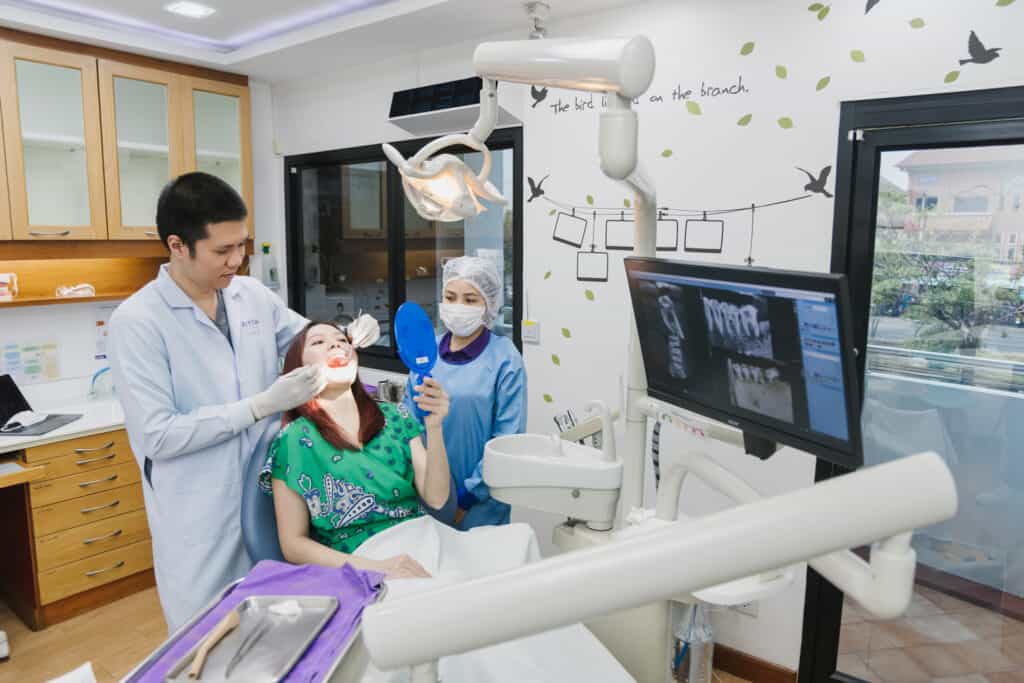
Below is the usual order of a dental examination for grinding. What each person needs, and how many visits it takes, depends on the case, and your dentist plans it together with you.
- Your story: when you notice grinding or clenching, how you feel on waking, and anything a partner has heard.
- Jaw muscles and joints: tender spots, how your mouth opens and closes, and joint sounds.
- Tooth wear: the pattern of wear, chips and cracks, and the condition of fillings, crowns and veneers.
- X-rays when needed, for a closer look at cracked teeth, restorations or the jaw joint.
- Your plan: your dentist explains what they found, whether a splint suits you, and what you can do yourself.
- If a splint suits you: a custom splint is made from a scan or impressions of your teeth, then fitted and adjusted so the bite feels even. The number of visits depends on each case, and your dentist explains it when planning.
- Follow-up: a splint and the bite are checked again over time, and your dentist suggests check-ups that suit your case.
If you have crowns, veneers or implants and you grind, a night guard is recommended to protect them. If snoring or pauses in breathing are part of the picture, your dentist can refer you to a hospital for a sleep test and coordinate your care. When worn teeth need restoring, the dental team plans that work with you.
If this sounds like you: what to do about grinding
These are example situations, not patient stories, to help you find the next step that fits.
A partner hears grinding, but nothing hurts
Start with the home steps and book a routine check. The dentist looks for wear and cracks. If the teeth are fine, watching it over time is often enough.
You wake with a tired jaw or a headache most mornings
Book an examination of the jaw muscles and joints. Warmth, rest and the jaw rest position help. A splint may be suggested to protect the teeth and ease the muscles.
You clench at the computer or while driving
This is awake bruxism. Reminders and the lips together, teeth apart position are the main tools. Your dentist can check whether the teeth or muscles need more.
You have crowns, veneers or implants
Mention the grinding before any new dental work. A night guard is recommended to protect these restorations, and your dentist checks how they fit your bite.
Your child grinds in their sleep
Often this is watched rather than treated. The children section above lists when a check is worth booking.
Your jaw clicks or catches
A jaw joint examination comes first. Care works well when several steps are combined: self-care, jaw exercises, less clenching and a splint when it suits you.
Teeth grinding: frequently asked questions
Is teeth grinding dangerous?
It is not a dangerous condition in itself. Over time it can wear or crack teeth, break fillings and crowns, and cause jaw pain and headaches, which is why it is worth checking when you notice signs.
How can I tell if I grind my teeth when I sleep alone?
Look for flat or shiny worn spots on the teeth, crack lines, a tired jaw or temples on waking, and teeth that feel sensitive. A dentist can usually see the pattern of wear during an examination.
Can teeth grinding go away by itself?
Often, yes. Children often outgrow it by their teens, and in many adults it eventually goes away. Until then, protecting the teeth matters more than stopping the habit.
Do I need a sleep test to diagnose teeth grinding?
Usually not. Most people are diagnosed from their story and the wear a dentist sees. A sleep test gives the most detailed picture and is used when it would change the plan, for example when sleep apnea is suspected.
Does stress really cause teeth grinding?
Stress is the most common link in health guidance, and surveys find more grinding in people with a very stressful life or anxiety. It is a link rather than the only cause, so managing stress helps many people but not everyone.
Are teeth grinding and snoring connected?
They often occur together. People with sleep apnea or loud snoring report grinding more often, but it is not clear which leads to which. If you snore loudly, mention it, because a different appliance and a sleep test may be needed.
Will a night guard stop the grinding for good?
A night guard is mainly there to protect the teeth and ease the muscles. Research shows oral appliances can reduce grinding activity in some people, but the habit may continue, so the splint works together with habit and sleep changes.
Summary
Teeth grinding is common and usually manageable. Understand your type, look after the factors linked to it, and protect your teeth when signs appear.
- Bruxism means grinding or clenching outside eating, in sleep, while awake, or both.
- Sleep grinding follows brief arousals and is linked to stress, snoring, alcohol, caffeine and smoking.
- Watch for worn or cracked teeth, a tired jaw on waking and morning headaches.
- Care works in layers: habits and sleep, a custom splint to protect the teeth, then repairs.
- Children often outgrow it; a check helps if there is wear, pain or loud snoring.
References
Ohayon MM et al. Risk factors for sleep bruxism in the general population. Chest, 2001
MedlinePlus, US National Library of Medicine. Bruxism