

Your dentist says a tooth has to come out, or you have already lost several, and now there are three ways forward: a removable denture, a bridge or a dental implant. All three sound sensible, but they differ a lot in the work involved, the number of visits and the care you give them each day. Some people worry that a denture will slip while they eat. Some dread surgery. Some are choosing for a parent and want to get it right.
The reassuring part first: no single option is right for everyone, and a removable denture is a proper, well-established choice rather than a lesser one. It needs no surgery, it does not need the neighboring teeth to be shaped for crowns, you take it out to clean it, and it can be adjusted or relined as your mouth changes. A bridge and an implant feel closer to natural teeth, but each comes with its own conditions. What matters is which set of conditions fits your mouth, your health and your plans.
This article walks through it in the order most people ask: a quick checklist to see which group you are in, what removable dentures are and which types exist, a side-by-side comparison with bridges and implants, how to choose for yourself or a parent, the visits step by step, getting used to a new denture, cleaning, sleeping with or without it, what to do when it gets loose, example situations, myths and facts, and your questions answered.
In short: a removable denture suits many mouths, especially when several teeth are missing, when surgery is not convenient, or when you want teeth right after an extraction. A bridge suits a short gap where the neighboring teeth need crowns anyway. An implant replaces a tooth without shaping its neighbors but needs enough bone and more time. Your dentist explains which fits after an examination and X-rays.
Which group am I in? A quick checklist
Read the three lists and tick what sounds like you. It is normal to fit more than one list. That simply means more than one option is worth discussing.
A removable denture is likely worth discussing if
- You have lost several teeth, or all the teeth in one jaw.
- Surgery is not convenient right now because of your health, your medicines or your schedule.
- A tooth is being removed and you want teeth to wear while the area heals.
- You would like to start with a removable option before deciding about implants.
- The neighboring teeth are healthy and you would rather not shape them for crowns.
- You are happy to take the denture out to clean it every day and to return for adjustments.
A bridge is likely worth discussing if
- One or two teeth are missing and the gap is short.
- The teeth on each side of the gap already need crowns, or are strong enough to carry a bridge.
- You want a fixed replacement without surgery.
- The missing tooth is at the front and your dentist suggests a Maryland bridge, which is mostly made for front teeth.
An implant is likely worth discussing if
- You want to replace a tooth without shaping the neighboring teeth.
- Your gums are healthy and the X-ray or 3D scan shows enough bone, or you are open to bone grafting first.
- You can plan for the healing time between visits and for regular check-ups afterward.
- You already wear a full denture that keeps moving and would like it to sit more steadily.
What a removable denture is
A removable denture is a set of replacement teeth made to fit your mouth that you can put in and take out yourself. The NHS describes complete dentures, which replace all the upper or all the lower teeth, and partial dentures, which replace one or more missing teeth. They are custom-made from impressions of your gums, usually in metal or plastic.
Why replace missing teeth at all? Not every gap needs treatment, but over time the teeth beside a gap can tilt toward it, the opposing tooth can grow toward the space, the bone where the tooth was can slowly shrink, and chewing becomes harder, which can change what you choose to eat. For front teeth, smiling and speaking can also feel different. A faculty of dentistry radio script from Naresuan University lists preventing neighboring and opposing teeth from tipping into the space as a main benefit of a denture, along with better chewing and more confidence in company.
Partial dentures
A partial denture fills the gaps between teeth you still have. It holds on to the remaining teeth with small clasps or with a flexible resin edge. Because it rests on both your teeth and your gums, the remaining teeth need to be kept clean and checked, so they stay healthy enough to hold it.
Full dentures
A full denture replaces every tooth in a jaw and rests on the gums. An upper denture is held by close contact with the palate and the thin film of saliva. A lower denture has less surface to hold on to and the tongue moves around it, so it often feels less steady. This is the main reason lower dentures are the ones people most often want to anchor on implants.
Immediate dentures
An immediate denture is fitted right after teeth are removed, so you are never without teeth while the area heals. The ADA (MouthHealthy) and the NHS both note that it may need adjusting, relining or replacing as the gums and bone settle, which is why it is treated as a first step rather than the final denture.
Types of removable dentures: material and framework
The word denture covers several designs. This table sets out the ones your dentist is likely to talk about. It is a guide, not a prescription, because the right one depends on the teeth, gums and bone you have.
| Type | Good to know | Often suits |
|---|---|---|
| Partial denture, acrylic base | Pink acrylic base with wire clasps. At the clinic it is made as a temporary denture, worn right after extractions. Acrylic is easy to repair but breaks more easily and is thicker than a metal framework. | Right after an extraction, while the gums settle. |
| Partial denture, metal framework (Cr-Co) | A thin cobalt-chromium framework carries the teeth and clips onto your own teeth. It is thin and rigid, and covers less of the gums and palate than acrylic. Clasps can show when you smile. | Long-term use, when there are enough natural teeth to hold it. |
| Flexible partial denture (Valplast) | Made from a flexible resin with gum-colored clasps and no metal. It blends in well. Flexible resins can become rougher or stained over time, so polishing, relining at the lab and regular checks keep it comfortable. | People who do not want metal clasps to show, especially near front teeth. |
| Full denture | Replaces all the teeth in a jaw, with an acrylic or metal base. A digital full denture, designed on a computer and milled, is also available. | No natural teeth left in that jaw. |
| Immediate denture | An acrylic denture worn right after teeth are removed. It is adjusted as the gums heal and usually replaced after a few months. | Anyone who wants teeth to wear while the area heals. |
| Implant-retained denture | A removable denture that clips onto implants, so it moves less when you eat and speak. You still take it out to clean it. | People whose denture, especially a lower one, keeps moving. |
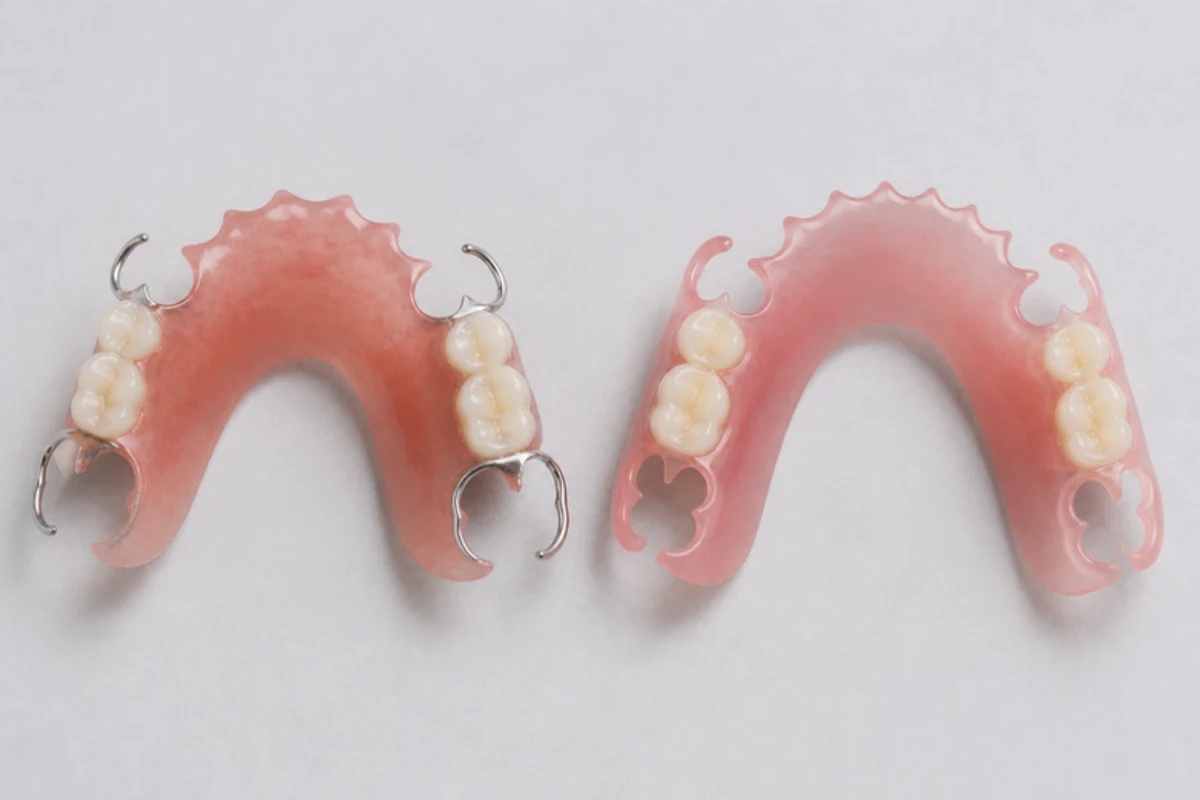
A word on acrylic partial dentures. They work well as a temporary denture after extractions. For longer-term use, your dentist usually recommends a metal framework (Cr-Co) or a flexible denture (Valplast), and the difference between acrylic and metal is explained in more detail in a separate article. Dentists also combine materials, for example a metal framework for support with flexible clasps for looks. A clinical review of partial denture design describes these blended designs as a way to improve fit, function and appearance.
Acrylic or metal-framework partial dentures: the difference
Removable denture, bridge or implant: side by side
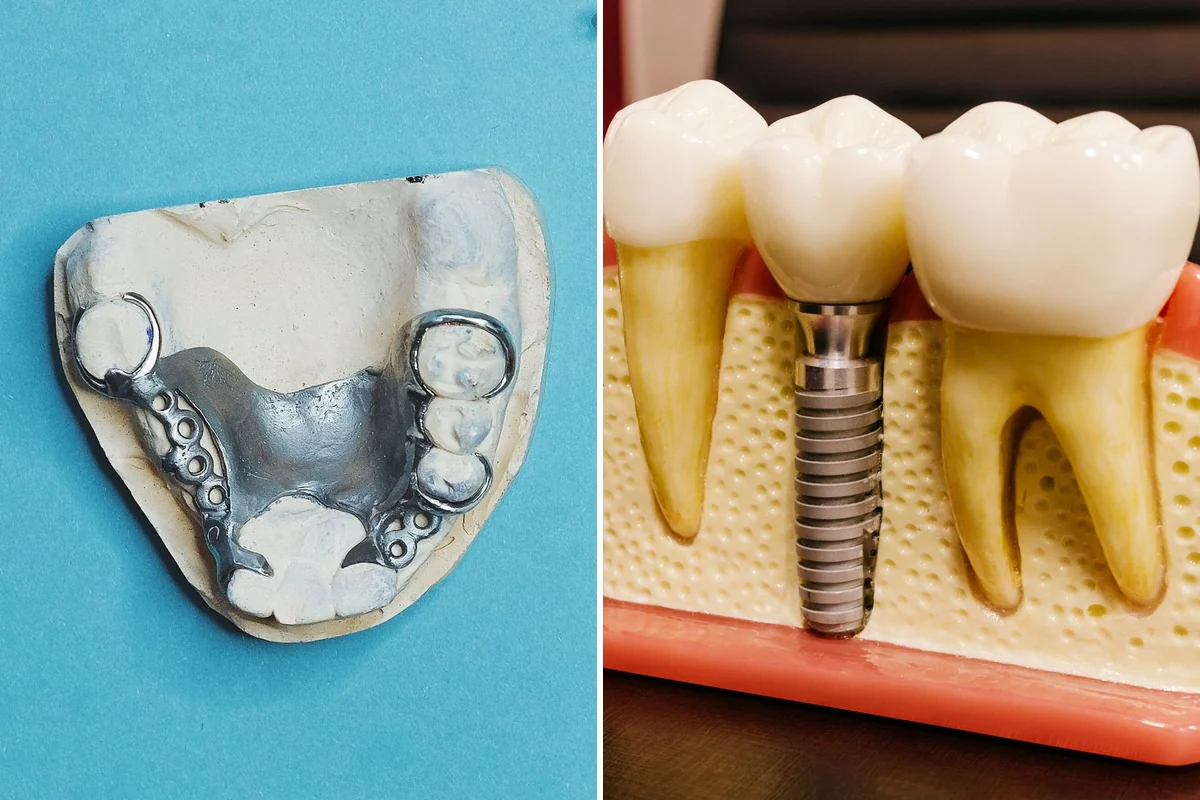
Here are the three options compared on the points people ask about most. The tables are split into three so each stays easy to read on a phone. Read across a row to see one option, or down a column to compare. The clinic facts in the tables come from our treatment pages, and the research is cited in the sources at the end.
Neighboring teeth, bone and surgery
| Option | Neighboring teeth | Bone and surgery |
|---|---|---|
| Removable denture | Not shaped for crowns. A partial denture holds on to remaining teeth with clasps, so those teeth need extra cleaning and regular checks. | No surgery. Nothing is placed in the bone. Gums and bone change over time, so a denture may need relining. |
| Fixed bridge | The teeth on each side are shaped for crowns that hold the bridge. A Maryland bridge uses small wings bonded behind the neighbors and needs little or no shaping. | No surgery. Nothing is placed in the bone under the replacement tooth. |
| Single implant with crown | Neighbors are left unshaped. | Needs enough bone and minor surgery under local anesthesia. Bone grafting or a sinus lift may be needed first. |
| Denture clipped onto implants | Neighbors are not needed for support. The implants carry the denture. | Implants are placed in the bone with minor surgery. The ADA notes that implants can help support an overdenture. |
Daily care and how it feels
| Option | Daily care | How it feels |
|---|---|---|
| Removable denture | Take it out, brush it over a basin of water and keep it in water or cleaning solution overnight. | Bulkier than natural teeth. It can feel strange for the first few weeks, and chewing is usually less efficient than with fixed teeth. |
| Fixed bridge | Brush as usual and clean under the replacement tooth every day with a floss threader, special floss or a small interdental brush. | Fixed in place, so it feels much closer to natural teeth. |
| Single implant with crown | Cleaned in the mouth like natural teeth, including around the implant. Scaling every 6 months and a yearly implant check are recommended. | Fixed, and close to a natural tooth when you chew and smile. |
| Denture clipped onto implants | Still removable, so it is cleaned out of the mouth. The attachments need care too, and a worn retention insert is replaced from time to time. | Steadier than a conventional denture when you eat and speak. |
Visits, time and who each option often suits
| Option | Visits and time | Often suits |
|---|---|---|
| Removable denture | Most dentures need at least 3–4 visits, and full dentures usually need more than partial ones. | Several missing teeth, surgery not convenient, or teeth wanted right after an extraction. |
| Fixed bridge | Usually two main visits, a few days apart while the laboratory works. If a tooth must come out first, the area usually heals for about two months before the bridge is made. | A short gap whose neighbors need crowns anyway. |
| Single implant with crown | Two stages: surgery, then usually 2–6 months of healing, then the new tooth. Your dentist confirms the timeline after a 3D CBCT scan. | Enough bone and healthy gums, and time for the stages and regular check-ups. |
| Denture clipped onto implants | Implants first, then the denture is made or adapted. Your dentist tells you the visits for your case. | People whose full denture, usually a lower one, keeps moving. |
Cost is not in the tables on purpose, because it depends on the type, the material and how many teeth are replaced. Every option and material is listed on the prices page, and your dentist explains the cost for your own case after the examination.
What research says about the trade-offs
Every option has its own typical problems, and knowing them helps you plan. In a systematic review of tooth-supported and implant-supported bridges, the most frequent problems with conventional bridges on natural teeth were biological: decay and loss of pulp vitality in the supporting teeth. Implant-supported work had more technical problems, such as chipping of the veneering ceramic and loosening of screws. Neither list is a reason to avoid an option. They are what check-ups are for.
For partial dentures, a study of 205 wearers found that the teeth clasped by the denture had more plaque, gum inflammation, gum recession and mobility than the teeth that were not, and concluded that good design and good cleaning can reduce the problem. A later systematic review in people with a history of gum disease found no strong evidence that a removable partial denture by itself destroys the gum support of teeth, although plaque tends to build up more, and it noted that these dentures improve quality of life, though to a lesser extent than fixed options. The practical lesson is simple: with a partial denture, the teeth that hold it deserve the most careful cleaning.
A Maryland bridge is a special case. A systematic review of resin-bonded bridges found that the most frequent complication was the bridge coming unstuck from the teeth, and that results were better for bridges placed at the front than at the back, and for bridges with a single retainer tooth. That fits the way Maryland bridges are made mostly for front teeth at the clinic.
Dental bridge or implant: which suits one missing tooth?
How to choose: seven things to weigh
Dentists work through the same questions, usually in this order. You can do the first pass yourself before the appointment, which makes the conversation more useful.
| What to weigh | Often points toward | The reason |
|---|---|---|
| 1. How many teeth are missing, and where | One or two in a short gap: bridge or implant. Several, or a whole jaw: removable denture, or implants carrying a bridge or a denture. | A bridge needs a sound tooth on each side. Implants can carry a bridge, so one implant per tooth is not always needed. |
| 2. The teeth beside the gap | Healthy and untouched: removable denture or implant. Already needing crowns: bridge. | A bridge shapes the neighbors for crowns, so it makes most sense when they need crowns anyway. |
| 3. Gums and bone | Enough bone and healthy gums: all three are possible. Little bone or gum disease: treat the gums first, then decide; a removable denture can bridge the wait. | Implants need bone to hold them and healthy gums around them. Infection around the implant, smoking and poorly controlled diabetes are among the reasons an implant can fail. |
| 4. General health and medicines | Bring your medicine list. Your dentist may ask your own doctor before some treatments. | Some medicines and conditions change how surgery and healing are planned. With blood thinners, some cases need no change and some need a word with your doctor first. Do not stop a medicine on your own. |
| 5. Budget | Look at each option and material on the prices page; your dentist explains the cost for your case. | The fee depends on the type, the material and the number of teeth. A fixed option can also have ongoing care to plan for. |
| 6. Time and travel | Short on time: a removable denture or a bridge. Able to plan stages: implants. | Implants need healing time between stages, so people from abroad plan two trips. Tell the clinic your dates before you book flights. |
| 7. Who will do the daily care | Hands, eyesight and memory all count. If cleaning is hard, say so: a fixed option or a simpler design may suit better. | A removable denture needs cleaning outside the mouth every day. A bridge and an implant need careful cleaning in the mouth. A family member or caregiver can learn the routine too. |
Questions worth taking to the appointment:
- Which of these three suits my teeth, gums and bone, and why?
- Is there a temporary step first, for example an immediate denture after an extraction?
- What will I need to do every day, and what will you check at follow-up visits?
- How many visits and how many weeks or months should I plan for?
- What is included in the cost of my own plan? The prices page lists the fees by category.
- If I choose a removable denture now, can I still move to implants later?
Before dental implant treatment: checks, visits and costs
Choosing for or with an older parent

When the person getting the denture is your mother or father, the decision is partly about teeth and partly about daily life: who helps with cleaning, how steady the hands are, whether the visits are manageable, and what your parent actually wants. Many older adults are happiest with the simplest plan that works. A good plan is one that your parent can keep up with after you go home.
Bring the health picture
At a senior oral-health assessment, your dentist reviews the health conditions and medicines first, checks for dry mouth, which is often linked to medicines, and examines the teeth, gums, existing dentures and the soft tissues inside the mouth. Dry mouth matters for dentures, because saliva helps a denture stay in place. Bring the list of medicines or the boxes, and tell the dentist about any sore spot under a denture, or a patch or lump that stays for more than two weeks.
When a full lower denture will not stay put
Expert groups have looked hard at this problem. The McGill consensus in 2002 and the York consensus statement in 2009 both concluded that for a person with no teeth in the lower jaw, a lower denture held by two implants should be the first choice, ahead of a conventional denture. A review of the studies behind those statements reports that satisfaction and quality of life were clearly better with the implant-held denture, and describes the two-implant version as a minimum standard that should be sufficient for most people once performance, satisfaction, cost and clinical time are weighed. It is a statement about a typical person, so your dentist still checks your bone and health. A more recent review adds that when the lower jaw bone has shrunk a lot, chewing stays limited whichever denture is used, so the shape of the ridge is watched over time.
Make the visits easier
- Treatment can be divided into shorter visits, and you can choose the time of day that suits your parent. The clinic is open every day from 09:00 to 20:00.
- With your parent’s consent, a family member or caregiver is welcome to come into the treatment room and hear the plan.
- The entrance has a ramp and no steps. There is a wheelchair-accessible restroom, a wheelchair you can borrow, a drop-off point in front of the clinic and parking for patients.
- If you live abroad, recent X-rays and reports can be sent ahead by WhatsApp, LINE or email so that the right dentist sees the case first.
To use the Social Security dental benefit for dentures, you pay at the clinic, the clinic prepares a medical certificate and a receipt, and you then claim the benefit yourself with these documents.
Social Security dentures: how to use your benefit
Step by step: making a removable denture
The exact order depends on whether teeth need to be removed and which type you choose. This is the usual path.
- Examination and planning. Your dentist checks your teeth, gums and bone with X-rays and explains the options, including bridges and implants, and gives you an estimate. If teeth need to come out, an immediate denture can be planned for the same day.
- Impressions and bite records. Impressions or a digital scan and jaw measurements are taken and sent to the laboratory.
- Try-in. You try the denture or the framework so the color, shape and fit can be checked and changed before it is finished.
- Fitting. The finished denture is fitted and your bite is checked.
- Follow-up. A new denture normally needs at least two or three adjustments. Follow-up visits are used to ease any sore spots, and you should not adjust the denture yourself.
- Regular check-ups. Gums and bone keep changing, so check-ups every six months let your dentist check the mouth and the denture and reline or adjust it before it becomes loose.
How many visits? Most dentures need at least three or four visits, including impressions, a try-in and fitting, and full dentures usually need more than partial dentures. If you are traveling, tell the clinic your dates so the visits can be planned around them. A digital full denture is designed on a computer and milled, and your dentist explains the visits for it.
The restoration carries a 1-year warranty, terms apply. Prices are listed by type and material on the prices page.
Getting used to it: chewing, speech and saliva
A new denture is a new object in the mouth, and the cheeks and tongue need time to learn it. The ADA says a new denture may feel awkward or loose for a few weeks while the cheek and tongue muscles adapt, and that mild irritation, soreness or extra saliva are common and should fade. This table covers what people notice most.
| What you notice | Usually | What to do |
|---|---|---|
| Feels bulky or strange | Common in the first few weeks. | Practise putting the denture in and out, and wear it as your dentist advises so you get used to it. |
| A lot of saliva | Often in the first days, then it settles by itself in two to three days. | Swallow the saliva rather than spitting it out. |
| Words sound unclear | Common at first, and it improves as you get used to the denture. | Practise the words that feel hard, and read aloud. If the denture clicks when you talk, have it checked. |
| A sore spot or rubbing | Normal for a new denture to need at least two or three adjustments. | Come back so the dentist can ease it. Do not file or bend the denture yourself, and take it out and keep it in water if you cannot wear it. |
| Hard to chew | Expected at first, because chewing with a denture is a new skill. | Start with soft food cut into small pieces, chew slowly and on both sides, and avoid sticky or hard food. Use the back teeth rather than biting with the front ones. |
The first weeks are the hardest part, and most people find it gets easier. If soreness does not settle, tell your dentist: the ADA advises reporting persistent irritation or soreness. The NHS lists a denture that slips, hurts, no longer fits or is damaged as a reason to book a visit, not an emergency.
Cleaning and storing your denture
A denture collects plaque the way teeth do, so it needs a daily routine. This one follows the NHS, the ADA and our treatment page.
- Rinse the denture after meals to wash off loose food.
- Clean it over a basin of water or a soft towel, because a dropped denture can break.
- Brush every surface daily with a soft brush and water or denture cleaner. The NHS advises against toothpaste, which can damage a denture.
- Brush your own teeth, gums, tongue and palate morning and evening with fluoride toothpaste. With a partial denture, take extra care around the teeth that hold the clasps.
- Never use hot water, which can warp the denture.
- When it is out of the mouth, keep it in water or cleaning solution so that it does not dry out or warp.
Which product cleans well? A Cochrane review of the trials found that brushing and soaking in cleaning products both appeared to reduce plaque on complete dentures compared with a placebo, but there were too few well-designed trials to say which method is better. In plain terms, doing the routine every day matters more than the brand, and your dentist can suggest a product for your denture.
Keep an eye on the gums under the denture as well. Denture stomatitis, redness and inflammation of the tissue covered by the denture, is common in wearers, with prevalence in studies ranging from 15% to over 70%. A review of its causes lists poor denture hygiene, wearing the denture continuously including at night, plaque on the denture and a poor fit. If your gums are very red or bleeding, or you notice bad breath, the NHS suggests booking a check, because these can signal gum disease, a fungal infection or decay.
Sleep with it in, or take it out?
The short answer: take it out at night, unless your dentist has told you to keep it in for a particular reason. The NHS says to remove dentures every night and store them in water or cleaning solution, and to wear them overnight only if the dentist recommends it, because trapped food raises the risk of gum infection and decay and there is a choking risk. The Naresuan University dentistry script gives the same advice so that the gums can rest, and warns that wearing a denture through the night can leave the gums red and inflamed and lead to a fungal infection in the mouth.
There is research behind this. A study that followed 524 community-living people aged 85 and over for three years found that those who wore their dentures during sleep had about a 2.4-fold higher risk of pneumonia than those who removed them at night. They were also more likely to have plaque on the tongue and denture, gum inflammation and Candida in the mouth. This was an observational study, so it shows an association rather than proof, and swallowing difficulty and other health problems also played a part. Still, taking the denture out at night is a small habit that costs nothing, and the evidence points the same way as the dental advice.
When a denture gets loose
A denture that fitted well a few years ago can start to move. The NHS explains that gums and jawbone can shrink or change shape with age, so dentures may become loose, and the Naresuan University script notes that the jawbone gradually shrinks after teeth are lost, which is why it advises a check every six months. The table sets out common situations and what usually helps.
| What you notice | What to do | The reason |
|---|---|---|
| Slightly loose, gums have changed | A reline or an adjustment, depending on the denture. Dentures made elsewhere can have a base added, depending on their condition. | Gums change shape over time, so the base no longer matches them. |
| A clasp has loosened, or the base is cracked | Repair by the dentist and the laboratory. | A broken piece can also catch in the airway, so it is not a job for glue at home. |
| Still fits fairly well, but you would like a little more hold | Denture adhesive can help while the denture still fits. Use a small amount as the label says and wash it off every day. | Adhesive is a helper, not a fix for a denture that no longer fits. |
| Still moves a lot, especially a lower denture | A denture that clips onto implants may help. Your dentist checks bone and health first. | Implants give the denture something fixed to hold on to. |
| Loose, with red or bleeding gums or bad breath | Book a check. Your dentist looks for gum disease, a fungal infection or decay. | A loose denture can irritate the gums, and the gums can in turn make a denture feel loose. |
The full guide to denture adhesive, including how to use it, what to look out for and when a reline is the better fix, is in a separate article.
A loose denture: do you need denture adhesive?
At the clinic: what we do for removable dentures
- Dentures are planned by dentists with postgraduate training in prosthodontics, the field of crowns, bridges and dentures, and made by our ISO-certified partner laboratory.
- The types available are full dentures, partial dentures with a metal framework, flexible partial dentures (Valplast), immediate dentures, dentures that clip onto implants, and digital full dentures.
- Relines, repairs and adjustments are available for the denture you already wear, and a denture made elsewhere can have its base added depending on its condition.
- If implants may suit you, your dentist checks your bone with an examination and a 3D CBCT scan before recommending an option. The implant systems used are Straumann, Neodent Zi and Dentium.
- Coordinators reply in English and Thai, and a coordinator who speaks Chinese is available. Tell us which teeth are missing and whether you already wear a denture, and we will book a time with a dentist.
If this sounds like you: what to do
These are example situations, not patient stories, to help you find the next step that fits.
- One front tooth is lost and the neighbors are healthy: an implant leaves the neighbors untouched, and a Maryland bridge, which is mostly made for front teeth, needs little or no shaping. A removable denture can cover the gap while you decide.
- One back molar is lost and both neighbors have large fillings that need crowns: a bridge is reasonable, because the crowns are needed anyway. An implant is also worth comparing if the bone is enough.
- Several teeth are missing on both sides and you would rather avoid surgery for now: a partial denture with a metal framework, or a flexible one if you do not want metal clasps to show, can be made. Implants can still be considered later.
- A tooth will be removed next week and you do not want to be without teeth while it heals: an immediate denture can be fitted right after the extraction, and it is adjusted as the gums heal.
- Your lower full denture keeps moving when you eat: ask for a check of the fit first, because a reline or adjustment sometimes solves it. If it still moves, a denture that clips onto implants is the option to discuss.
- Your mother is in her eighties, takes several medicines and her hands are not steady: a well-made removable denture with a simple cleaning routine may suit her, with a family member learning the routine too. Ask for a senior oral-health assessment first.
- You are visiting Chiang Mai for two weeks: a denture or a bridge can usually be planned around a trip, while implants need stages with healing time between them. Send X-rays ahead and tell the coordinator your dates.
Common myths and the facts
| Myth | Fact |
|---|---|
| A removable denture is always a temporary or lesser choice. | Dentists choose by teeth, gums, bone and health. Acrylic partial dentures are made as temporary ones, while a metal framework (Cr-Co) or a flexible denture (Valplast) is used for the longer term. |
| Wear the denture at night so it keeps its shape. | Take it out at night and keep it in water. That rests the gums and keeps the denture from drying out or warping. |
| Toothpaste is a good way to clean a denture. | The NHS advises against toothpaste, which can damage a denture. Use a soft brush with water or denture cleaner. |
| Adhesive fixes any loose denture. | It can help while the denture still fits. A denture that no longer fits needs a reline or an adjustment. |
| A denture chews just like natural teeth. | Chewing is usually less efficient than with natural or fixed teeth, and it is a skill you learn. A denture still brings real benefits for quality of life, and an implant-held denture sits steadier. |
| A partial denture will ruin the teeth that hold it. | A systematic review found no strong evidence that a removable partial denture by itself destroys gum support, although plaque builds up more. Careful cleaning of the clasp teeth and regular check-ups keep them healthy. |
| A bridge or an implant needs no cleaning care. | Both are cleaned in the mouth every day, including under the bridge and around the implant, and both need regular check-ups. |
Frequently asked questions about removable dentures
What is the difference between a removable denture, a bridge and an implant?
A removable denture is taken out for cleaning and needs no surgery. A bridge is fixed and held by crowns on the teeth either side of the gap. An implant replaces the root of the tooth and carries a crown without shaping its neighbors. The three tables above compare them on the neighboring teeth, bone and surgery, daily care and feel, and visits.
How long does it take to make a removable denture?
Most dentures need at least three or four visits, including impressions, a try-in and fitting, and full dentures usually need more visits than partial dentures. Your dentist gives you a visit plan after the examination. If you are traveling, tell us your dates so the visits can be planned around them.
Will I be able to talk and eat normally with a new denture?
Most people can, after an adjustment period of a few weeks. Speech usually improves with practice, extra saliva settles within a few days, and chewing becomes easier when you start with soft food in small pieces. If the denture clicks, rubs or hurts, have it adjusted, and expect at least two or three adjustment visits.
Which is better, a flexible or a metal-framework partial denture?
They suit different situations rather than one being better. A flexible denture has no metal clasps. A metal-framework denture is thin and rigid. Your dentist recommends one based on your remaining teeth and gums. Acrylic partial dentures are made as temporary dentures, and the acrylic-or-metal article explains the difference in more detail.
Can I have teeth on the day a tooth is removed?
In suitable cases, an immediate denture can be fitted right after the extraction. It is adjusted as the gums heal and is usually replaced after a few months with a longer-term denture or another option. Your dentist tells you whether it suits your case.
Should I take my denture out at night?
Yes, unless your dentist has told you to keep it in for a particular reason. The NHS and a Thai dental faculty both advise taking it out and keeping it in water or cleaning solution. Research has linked sleeping in dentures with more plaque, gum inflammation and a higher risk of pneumonia in very elderly people.
My denture is loose. What can be done?
A loose denture can often be relined or adjusted. If it still moves too much, a denture that clips onto implants may help. Denture adhesive can help while the denture still fits, used in small amounts as the label says and washed off every day. Your dentist checks it and explains the options.
How do I clean a removable denture?
Rinse it after meals and brush it daily with a soft brush and water or denture cleaner, not toothpaste. Do it over a basin of water, never use hot water, and keep it in water or cleaning solution overnight. Also brush your own teeth, gums, tongue and palate morning and evening.
Can I use my Social Security benefit for dentures?
Yes. You pay at the clinic, the clinic prepares a medical certificate and a receipt, and you claim the benefit yourself with these documents. Direct billing is available for eligible Cigna, Allianz, International SOS and April patients after benefit verification, so contact us before your visit.
Is there a warranty on removable dentures?
Yes. Dentures and other laboratory work have a 1-year warranty on the restoration, terms apply. The warranty is used at our clinic in Chiang Mai and does not include travel, accommodation or treatment provided elsewhere.
Summary
- A removable denture is a proper long-term choice when it is well made and well looked after, and it needs no surgery.
- Choose by the number of teeth missing, the neighboring teeth, bone and gums, your health and medicines, budget, time, and who will do the daily care.
- Allow a few weeks to get used to a new denture, expect two or three adjustment visits, and start with soft food in small pieces.
- Clean it every day with a soft brush and water or denture cleaner, take it out at night and keep it in water.
- See your dentist every six months, and ask early about a reline or implants if the denture starts to move.
Ready to talk it through? Bring your questions, your medicine list and any X-rays you have, and your dentist will examine your mouth and explain the options before any treatment starts. You are welcome to bring your parents along too.
References
NHS (UK): Dental treatments, including bridges, dentures and implants
American Dental Association (MouthHealthy): Dentures
Faculty of Dentistry, Naresuan University: removable dentures, advice and care (radio script)
Epidemiology and etiology of denture stomatitis. Journal of Prosthodontics, 2011
Interventions for cleaning dentures in adults. Cochrane Database of Systematic Reviews, 2009
Removable partial dentures: clinical concepts. Dental Clinics of North America, 2014