

You may have been told that a missing tooth can be replaced with an implant, and then the questions begin. What will the dentist check first? Will I need a bone graft? How long does the whole treatment take? What affects the cost? Most people want these answers before they book, not after.
A dental implant is a small post placed in the jawbone. After the bone has healed around it, an abutment is attached and a crown is fixed on top. The treatment is planned in stages, and the planning before surgery decides much of how smoothly the rest goes. That is why this article starts with the preparation.
Here you will find a self-check, what your dentist examines and why, what a 3D CBCT scan shows, what happens when there is not enough bone, the stages in order, what to think about if you travel far, what affects the cost, who carries a higher risk, what to bring to your first visit, and answers to the questions people ask most.
In short: before implants, your dentist reviews your health history and medicines, your gums and neighboring teeth, and your bone on a 3D CBCT scan. If bone is short, a bone graft or sinus lift may be added. Treatment is done in stages with healing time between them, and your dentist explains the plan and timeline for your own case.
Which group are you in? A quick self-check
No checklist replaces an examination, but it shows what to sort out before you come and what to mention at the first visit.
Ready to start the planning
- Your remaining teeth and gums are healthy, or any decay and gum problems have already been treated.
- You do not smoke, or you have already stopped.
- You have no long-term illness, or it is well controlled and your doctor knows about the plan.
- The gap has been there only a short time, so there is likely more bone to work with.
Sort out a few things first
- You smoke or vape: talk with your dentist about stopping before and after surgery.
- Your gums bleed or you have been told you have gum disease: treat it first so the implant has healthy tissue around it.
- You have diabetes: bring your recent results so your dentist can see how well it is controlled.
- You grind your teeth at night: tell your dentist, because a night guard may become part of the plan.
Ask your doctor and dentist together
- You take blood thinners, osteoporosis medicines or other long-term medicines: do not stop them yourself. Your dentist may ask to consult the doctor who looks after you.
- You have a heart valve condition or a joint replacement: tell your dentist, who plans your care with you and, where needed, with the doctor who looks after you.
- You are pregnant or planning a pregnancy: tell your dentist, who plans the timing with you.
The treatment at a glance: what, when and how long
| Stage | What is done | Time |
|---|---|---|
| Planning and surgery | Examination, CBCT scan, treatment plan, then implant surgery under local anesthesia. Bone grafting is done now if your plan includes it. | Planned with your dentist |
| Healing time | The bone grows onto the implant. You can go home during this time. Bone grafting or a sinus lift can make it longer. | Often a few months; sources give 3 to 9 months |
| Final tooth | Your dentist checks the implant, takes an impression or digital scan, and fits the crown or bridge. | Planned with your dentist |
Times vary from person to person. Your dentist confirms your own timeline after the CBCT scan, because the amount of bone and any extra procedures change it. Sources give wide ranges for the healing period, and you will find them quoted later in this article.
What your dentist checks before implants, and why
Planning an implant can involve more than one dental specialty, such as oral surgery and prosthodontics, because treatment needs at least one operation. According to a Naresuan University dental faculty radio script, the planning covers an oral examination, a 3D radiograph and models of the teeth and ridge when needed, a review of your medical history, a discussion of what result you expect and how many implants are planned, and getting your mouth clean and healthy first.
| What the dentist checks | Reason for the check | What to bring or say |
|---|---|---|
| Health history and medicines | Some conditions and medicines change healing or the way surgery is planned. | A list of medicines, allergies and the doctor who treats you |
| Gums and remaining teeth | Decay and gum disease are treated first, so the implant sits in a healthy mouth. | Tell your dentist if gums bleed or teeth feel loose |
| Teeth next to the gap and the opposite tooth | Space, tilting and bite decide how the new tooth is shaped. | Mention grinding, clenching or jaw pain |
| Bone height, width and position | The implant needs enough healthy bone around it. A 3D scan shows nerves and the sinus too. | Any recent X-ray or CBCT you already have |
| Smoking and daily habits | These are linked with healing and with gum health around the implant. | Be open about smoking, vaping and how you clean your teeth |
Implants are not the only way to replace teeth. A bridge or a removable denture can also suit you, and your dentist explains the options after the examination. If you are replacing only one tooth, the page on replacing a single missing tooth compares the three choices side by side.
Replacing a single missing tooth
The 3D CBCT scan: what it shows
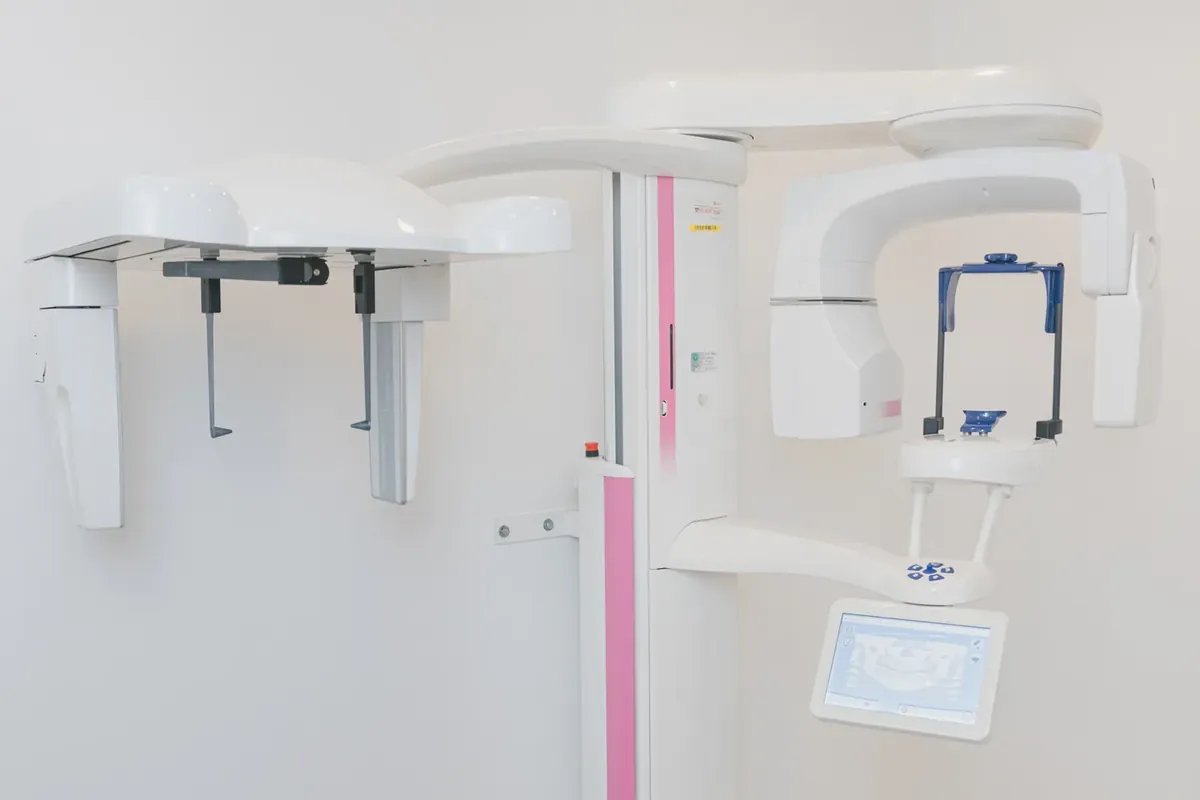
A CBCT scan is a three-dimensional X-ray of the jaws. A normal flat X-ray cannot show how thick the bone is, so the scan gives your dentist the missing dimension: bone height and width, the position of the nerve in the lower jaw, and the floor of the sinus above the upper back teeth. It also lets the implant position be planned on the computer before surgery.
Reviews of the evidence agree that dose depends heavily on the machine and the settings. A review in BMC Oral Health (Jacobs and colleagues, 2018) reported effective doses ranging from about 2 to 200 panoramic X-rays for similar indications, and a systematic review in the International Journal of Oral and Maxillofacial Implants (Bornstein and colleagues, 2014) found the lowest dose was almost 100 times lower than the highest, with dose reduced by adjusting exposure settings and limiting the field of view. So dose differs between machines and settings, and the dentist chooses settings to suit what the scan is for.
If radiation worries you: at the clinic, X-rays inside the mouth are digital, taken with phosphor plates and sensors that help lower the dose compared with film. The Planmeca ProMax CBCT has an Ultra Low Dose mode, your dentist chooses the mode that suits each case, and X-rays are taken only when they are needed. If you are pregnant, tell your dentist before any X-ray.
Dental X-ray radiation: how much is it, and how we keep it low
You can send a CBCT you already have, and your dentist reviews it. A scan from another place helps with a first opinion, and the final plan still needs an examination in person.
Dental 3D X-ray (CBCT): what it is used for
If the bone is not enough
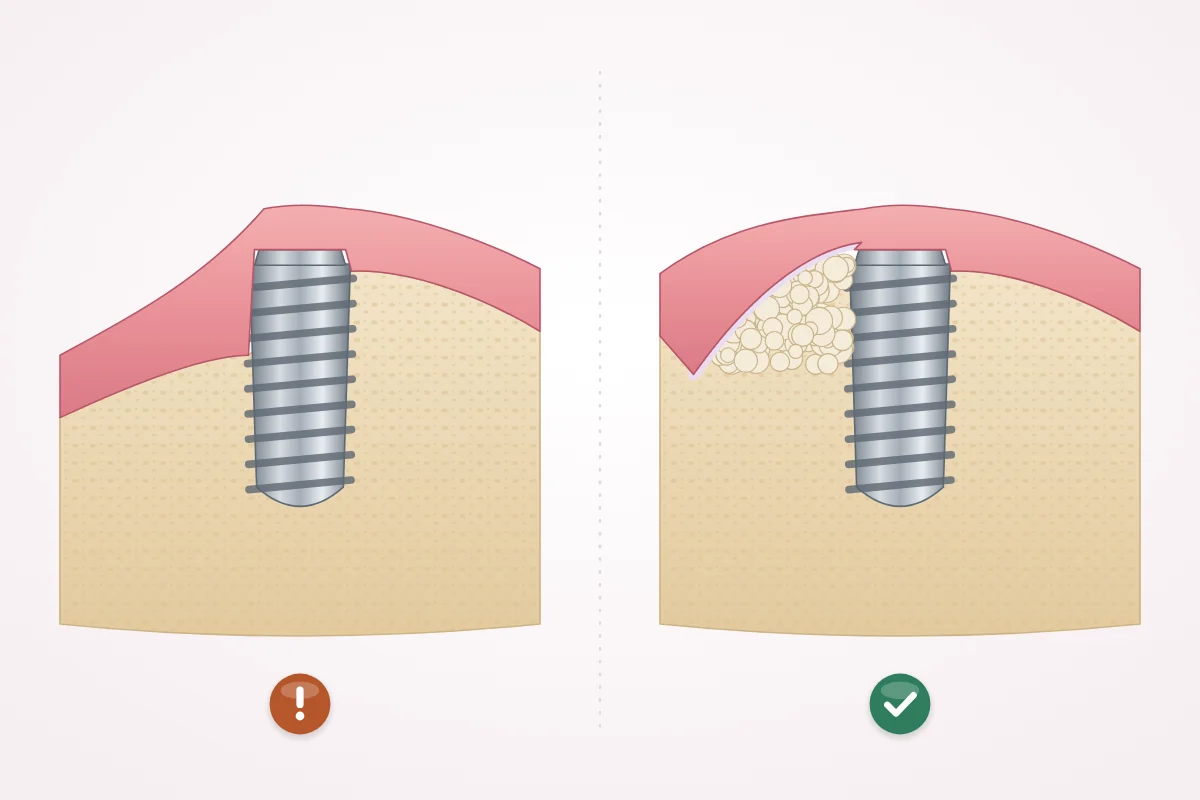
An implant needs enough healthy bone to hold it. Cleveland Clinic names this as the main requirement. A graft may be considered when a tooth was removed long ago and the bone has shrunk, when gum disease has caused bone loss, when an upper back tooth sits close to the sinus and leaves little height, or when an implant is planned right after an extraction and the socket needs filling. A graft is not always needed: your dentist decides from the CBCT scan and explains how it changes your plan and timeline.
| Graft type | What the graft involves | When it is used |
|---|---|---|
| Graft during implant surgery | Graft material is added around the implant during the same surgery. | Small amounts of missing bone |
| Ridge augmentation before implants | Bone is built up first and allowed to heal before the implant is placed. | Larger defects |
| Sinus lift | The sinus floor is gently lifted and bone material is placed beneath it to gain height. | Upper back teeth with little bone height |
A membrane is often placed over the graft to protect it while it heals. Your dentist explains which graft material suits your case. Under local anesthesia the gum is opened, the material and often a membrane are placed, and the gum is closed with stitches. According to the Cambridge grafting leaflet, stitches are usually removed after seven to ten days, and your dentist checks the healing.
How long does the bone take? Cambridge University Hospitals NHS says that if you need bone grafting, treatment is prolonged by at least four months, and its grafting leaflet says the new bone may take between four and twelve months to grow into the graft. When a small graft is placed together with the implant, it heals during the normal implant healing time. Smoking is linked with a higher risk of graft failure, according to the same leaflet. Your dentist checks the bone again before placing the implant.
The stages in order, from first visit to the new tooth
- Examination, CBCT and plan. Your dentist reviews your history, examines your mouth, checks the bone on the scan, and gives you a treatment plan.
- Getting the mouth ready. Decay and gum disease are treated first. A tooth that cannot be saved is removed. If bone is short, a graft or sinus lift is planned.
- Implant surgery. Under local anesthesia, the gum is opened, a hole is prepared in the planned position, the implant is placed and the gum is closed with stitches. Inhaled or oral sedation is available if you feel anxious.
- Healing. The bone grows onto the implant. This often takes a few months, and you can go home during this time.
- Abutment and impression. Your dentist checks that the implant is firm, attaches the abutment, and takes an impression or a digital scan for the crown.
- The new tooth. The crown or bridge is fitted and the bite is checked. You receive advice on cleaning around the implant.
Other sources give different healing ranges, and they are worth knowing. Cleveland Clinic writes that bone fusion (osseointegration) can take anywhere from three to nine months depending on how quickly your body heals. Cambridge University Hospitals NHS says the wait usually takes three to six months but can be longer, and that total treatment is usually at least a year. Naresuan University describes about two to three months. The ranges differ because bone, the site and the extra procedures differ, which is why your own timeline comes from your scan and not from an average.
In suitable cases the implant can be placed at the same visit as the extraction. In some cases a temporary tooth can also be fitted straight away, depending on how stable the implant is. The final crown is still made after the bone has healed. Immediate placement suits you only if there is no active infection and there is enough bone to hold the implant firmly, and your dentist decides after the CBCT scan.
How many visits, and how to plan if you travel far
Implant treatment is done in stages, so most people come at least twice: once for the examination, CBCT scan and surgery, and again for the final tooth after the healing time. How many days each visit takes and how long the healing lasts depend on your case, and your dentist plans it with you. After a sinus lift, avoid flying until your dentist tells you the area has healed enough.
Before you book flights
- Send recent X-rays, scans or clear photos to the clinic. A dentist in the relevant specialty reviews them and gives a preliminary opinion.
- Tell the coordinator your travel dates, so the visits can be planned around them. Coordinators reply in English and Thai, and a coordinator who speaks Chinese is available on LINE.
- Remember that photos allow a preliminary opinion only. The final plan and fee are confirmed after an examination in person.
- Book flights for the second trip only after the first trip tells you how long the bone needs.
If you find English spoken at speed hard to follow, your dentist can explain again, or send the explanation as a written message by email or WhatsApp. The clinic is open every day from 09:00 to 20:00, and closed on 31 December, 1 January and 13 to 15 April.
Planning treatment from abroad
All-on-4 or All-on-6: how many trips and how long in Chiang Mai
What affects the cost of implant treatment
The cost depends on the treatment your dentist plans for you: the implant itself, the parts that connect it to the crown, the crown, and any extra steps your case needs, such as a scan or a bone graft. Your dentist explains your plan before treatment starts. The prices page lists the fees by category.
Implant parts and systems
An implant has three parts: the post in the bone, the abutment that connects, and the crown. At the clinic, implants come from Straumann (BLX, Roxolid SLActive), Neodent (Zi) and Dentium, and your dentist recommends the system that suits your case after checking your bone on the CBCT scan.
Pain, medicines and recovery
The area is numbed with local anesthesia, so you should feel pressure during surgery rather than sharp pain. Tell your dentist at once if you feel anything sharp. If you feel anxious, inhaled sedation or oral sedation is available for suitable cases, and your dentist explains which fits you.
Afterwards, swelling, bruising, soreness and a little bleeding are common, according to Naresuan University. Soreness and swelling for a few days is usual, and your dentist advises on pain relief. Cleveland Clinic describes about one week for the first recovery, and the Cambridge grafting leaflet says stitches are usually removed after seven to ten days. How much time off work you need depends on how much surgery is planned and on your job, so ask before you set the date.
Call the clinic if the implant feels loose, bleeding does not settle, there is a fever, pus or increasing swelling. Do not stop long-term medicines on your own. For blood thinners, some cases do not need the medicine stopped, and in others your dentist may ask to consult the doctor who looks after you first.
Dental implant surgery: what it feels like and how long to rest
After dental implant surgery: aftercare from the first day to the new crown
Who carries a higher risk, and what to do about it
Implants are widely used to replace teeth, and some factors are linked with more problems. The table reports what reviews found. These are associations in groups of people, and your dentist weighs them for you one by one. Most of them can be managed, and several can change before surgery.
| Factor | What reviews report | What helps |
|---|---|---|
| Smoking | A meta-analysis of 292 publications found implants in smokers had a higher failure risk, with an odds ratio of 2.4, and about 0.58 mm more marginal bone loss. | Stop before surgery and stay stopped. Your dentist advises how long before and after surgery. |
| Diabetes | An update review found poorly controlled diabetes goes with more peri-implantitis and higher implant loss in the long term, while under controlled conditions success rates are similar. | Bring recent results. Good control, with your doctor, comes first. |
| History of gum disease | A meta-analysis of prospective studies found a history of periodontitis is a significant risk factor for implant failure, peri-implantitis and more bone loss, with low certainty of evidence. | Treat gum disease first and keep regular cleaning visits. |
| Grinding and clenching | A systematic review of 15 papers found bruxism is a probable risk factor for mechanical problems and higher failure, with a pooled odds ratio of 4.68. | A night guard is recommended to protect the crown on the implant. |
| Cleaning around the implant | Cambridge University Hospitals NHS notes that infection can occur if implants are not cleaned properly. | Your dentist shows you how to clean. Scaling every 6 months and an implant check once a year are recommended. |
Cleveland Clinic lists smoking or vaping, unmanaged diabetes, active gum disease, poor oral hygiene and severe jaw bone loss among the reasons an implant may not suit someone, and says only a dentist can tell you whether you are a candidate. Many people who have one of these factors can still have an implant after it is treated or controlled, so the plan is often adjusted to fit your situation.
What to bring to your first visit
A little preparation helps your dentist see the whole picture at the first visit. Your dentist then explains the plan to suit your own condition.
- A list of your medicines and allergies, and the name of the doctor who looks after you.
- Any recent X-ray or CBCT scan you already have.
- A note of long-term conditions such as diabetes, heart or bone conditions, and recent test results if you have them.
- Whether you smoke or vape, and whether you grind or clench your teeth.
Questions that help you understand your own plan
If you would like to prepare before you see the dentist, these are questions many people find helpful for understanding their own plan. You do not need to ask them all; your dentist covers most of them as part of the explanation.
- Are my teeth, gums, bone and general health suitable for an implant, and are a bridge or denture options for me too? How do they differ in my case?
- Do I need a bone graft or another extra step? If so, how does it change my timeline and the number of visits?
- How do my health conditions and medicines, such as diabetes, blood thinners or smoking, affect the plan, and how should I prepare?
- What will I wear and eat while the bone heals?
- How should I look after the area after surgery, and which symptoms mean I should contact the clinic?
- How many visits will I need, and how can I plan travel and time off work?
- How will my implant be looked after in the long term, and when are the check-ups?
- What is included in the cost of my own plan? The prices page lists the fees by category.
If this sounds like you: what to do
These are example situations, not patient stories, to help you find the next step that fits.
- You are missing one tooth, a back molar lost some time ago: the dentist checks the bone on a CBCT scan. If the bone has shrunk, the plan may add a graft, and a bridge or partial denture remain options to compare.
- A front tooth is about to be removed: placing the implant at the same visit and fitting a temporary tooth are possible in some cases. They depend on infection, bone and stability, and your dentist assesses them.
- You smoke a pack a day: talk about stopping before any plan is fixed. Dates for surgery are set around that.
- You have type 2 diabetes: bring your recent blood sugar results. Controlled diabetes is not on its own a reason to say no.
- You live abroad and have two weeks: send your X-rays and travel dates first. Your dentist plans the visits with you around the healing time.
- You grind your teeth at night: mention it at the first visit. A night guard is a normal part of protecting the new crown.
- You take a blood thinner: do not stop it yourself. Your dentist may ask to consult your doctor first.
Planning implants at the clinic, step by step
- Send your question, a recent X-ray or a photo. A coordinator replies in English or Thai, and a dentist gives a preliminary opinion.
- At the first visit, your dentist examines your teeth and gums and checks your health history. A 3D CBCT scan measures the bone and the plan is made on it.
- You receive a treatment plan. Your dentist explains the options, including a bridge or denture, before anything starts.
- Implant surgery is done under local anesthesia, with inhaled or oral sedation if suitable. Your dentist checks the healing before you leave.
- After the healing time, the second trip: the implant is checked, an impression or digital scan is taken, and the crown or bridge is fitted.
- Afterwards, scaling every 6 months and an implant check once a year help keep the tissue around the implant healthy.
Implant treatment is planned and carried out by dentists with postgraduate training in implant dentistry, prosthodontics and oral surgery. When a case involves several fields, such as gum treatment or bone grafting before the implant, the dentists involved plan it together within the clinic.
Common myths about preparing for implants
| Myth | Fact |
|---|---|
| An implant is finished in one visit. | Treatment is done in stages. In suitable cases the implant can be placed at the extraction visit, and the final crown is made after the bone has healed. |
| Anyone can have an implant. | It needs enough healthy bone, healthy gums and a general health review. Your dentist decides after the examination. |
| Needing a bone graft means an implant is not possible. | Grafting or a sinus lift is a way to make an implant possible. It lengthens the healing time, and it is not needed in every case. |
| The body rejects an implant like a transplanted organ. | An implant is not rejected in that way, and allergy to implant materials is rare. It can still fail to join the bone, or be lost later, for example from infection, smoking, poorly controlled diabetes or difficulty keeping it clean. |
| An implant is not a real tooth, so it needs no care. | The gum and bone around it can still become inflamed. Daily cleaning, scaling every 6 months and an implant check once a year are recommended. |
| If I have diabetes, I cannot have an implant. | A review found no contraindication to implant surgery under controlled conditions, and success rates were similar. Poorly controlled diabetes carries more risk. |
Frequently asked questions before dental implants
How long do I need to stay in Chiang Mai for implants?
Implant treatment is done in stages, so most people come at least twice: for the examination, CBCT scan and surgery, and later for the final tooth after the healing time. The number of days and the healing time depend on your case, and bone grafting or a sinus lift can lengthen it. Your dentist plans the timeline with you after the CBCT scan.
Does implant surgery hurt?
The area is numbed with local anesthesia, so you should feel pressure rather than sharp pain. Tell your dentist if you feel anything sharp. Soreness and swelling for a few days afterwards is common, and your dentist advises on pain relief. Inhaled or oral sedation is available for suitable cases if you feel anxious.
Do I need a bone graft before an implant?
Only when there is not enough bone. It is more likely when a tooth was removed long ago, after gum disease, or for upper back teeth near the sinus. Your dentist decides from the CBCT scan.
Can the whole implant treatment be finished in a single visit?
Implant treatment is done in stages. In suitable cases the implant is placed at the same visit as the extraction, and a temporary tooth can be fitted in some cases, while the final crown is made after the bone has healed.
Can I have an implant if I have diabetes?
Often yes, when the diabetes is well controlled. An update review concluded there is no contraindication under controlled conditions, while poorly controlled diabetes is linked with more peri-implantitis. Bring your recent results, and your dentist may consult your doctor.
I smoke. Can I still have implants?
Smoking is linked with a higher risk of failure, so your dentist will ask you to stop before and after surgery. Cleveland Clinic lists smoking and vaping among reasons an implant may not suit someone. Talk about it early so the surgery date can be planned around your quitting.
Which implant brands does the clinic use?
Straumann (BLX, Roxolid SLActive), Neodent (Zi) and Dentium. Your dentist recommends the system that suits your bone and plan after the CBCT scan.
What affects the cost of an implant?
The cost depends on the plan your dentist makes for you, including the implant, its parts and crown, and any extra steps your case needs. Your dentist explains the plan before treatment starts, and the prices page lists the fees by category.
Can I send my X-rays before I travel?
Yes. Send recent X-rays, scans or photos to the clinic. A dentist in the relevant specialty reviews them and gives a preliminary opinion. The final plan needs an examination in person, because some things can only be checked in the mouth.
How do I look after an implant afterwards?
Clean around it every day as you would a natural tooth. The clinic recommends scaling every 6 months and an implant check once a year. Your dentist shows you how to clean around the crown.
Summary
Before implants, expect a health review, a gum and tooth check, and a 3D CBCT scan of your bone. Treatment is done in stages with healing time between them, longer if a graft is needed, and your dentist explains the plan for your own case.
- Tell your dentist about your medicines, smoking, diabetes and any grinding at the first visit.
- Treat gum disease and decay first so the implant has healthy tissue around it.
- Bring any recent X-ray or scan you already have, so your dentist can see it at the first visit.
- Book the second trip after the first trip tells you how long the bone needs.
- Read your estimate against the list of what is included and what is charged only if needed.
- After surgery, scaling every 6 months and an implant check once a year keep the area healthy.
References
Cleveland Clinic: Dental Implants
Cambridge University Hospitals NHS: Dental implants in restorative dentistry
Cambridge University Hospitals NHS: Bone grafting for dental implants