
Root canal treatment in Chiang Mai
Root canal treatment cleans infected or inflamed tissue from inside a tooth, seals the root canals, and aims to keep your natural tooth. At Kitcha Dental Clinic, serving Chiang Mai since 1981, your dentist first examines the tooth and takes X-rays, then explains whether root canal treatment, retreatment or another option suits it — and what happens at each visit.
- Open every day, 09:00–20:00
- Opposite Chiang Mai Gate
- Coordinators in English and Thai
Is this you?
- A toothache that lingers after something hot or cold.
- Pain when you bite or chew on one tooth.
- Swelling in the gum, or a small pimple on the gum near a tooth.
- A tooth that has turned darker than its neighbors.
- Deep decay, a large old filling, or a cracked or injured tooth.
- Your dentist has seen a change around the root tip on an X-ray — sometimes with no symptoms at all.
Any of these can have other causes, so your dentist examines the tooth before suggesting treatment.
What root canal treatment is
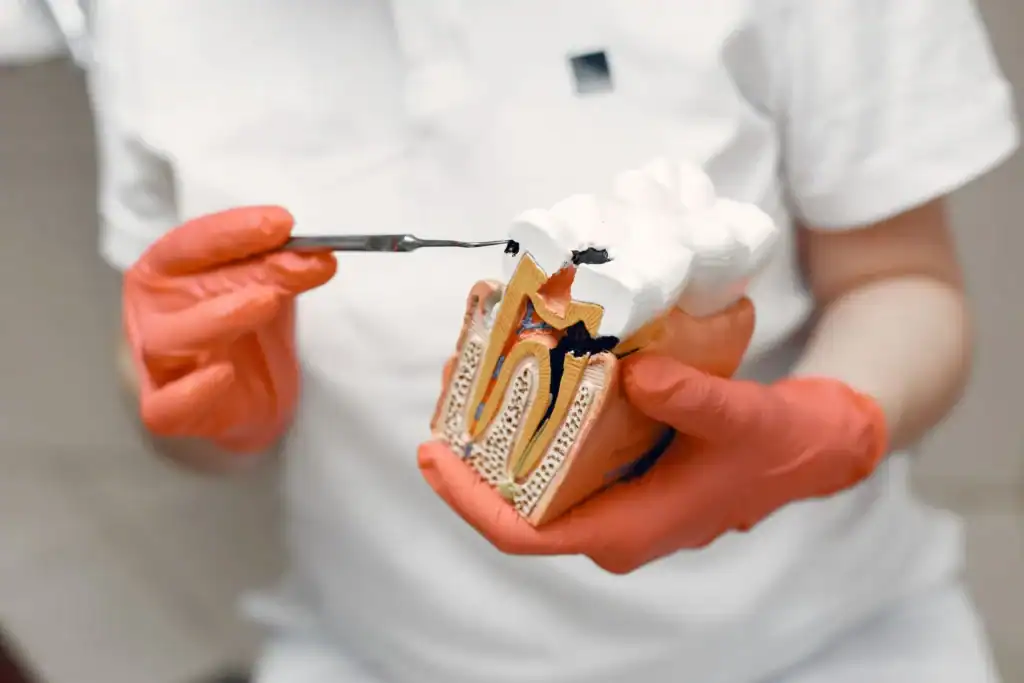
Inside every tooth is the pulp — soft tissue with nerves and blood vessels that runs from the crown down to the tip of each root. Deep decay, a crack or an injury can let bacteria reach the pulp, which then becomes inflamed or infected. Root canal treatment removes this tissue, cleans and shapes the canals inside the roots, and fills and seals them so the tooth can stay in your mouth and keep working.
After treatment, the tooth works without its pulp. It stays firmly in the jaw, supported by the bone and gum around it, but it can become more brittle and may darken over time — which is why most treated back teeth need a crown or onlay afterward.
How we assess your tooth
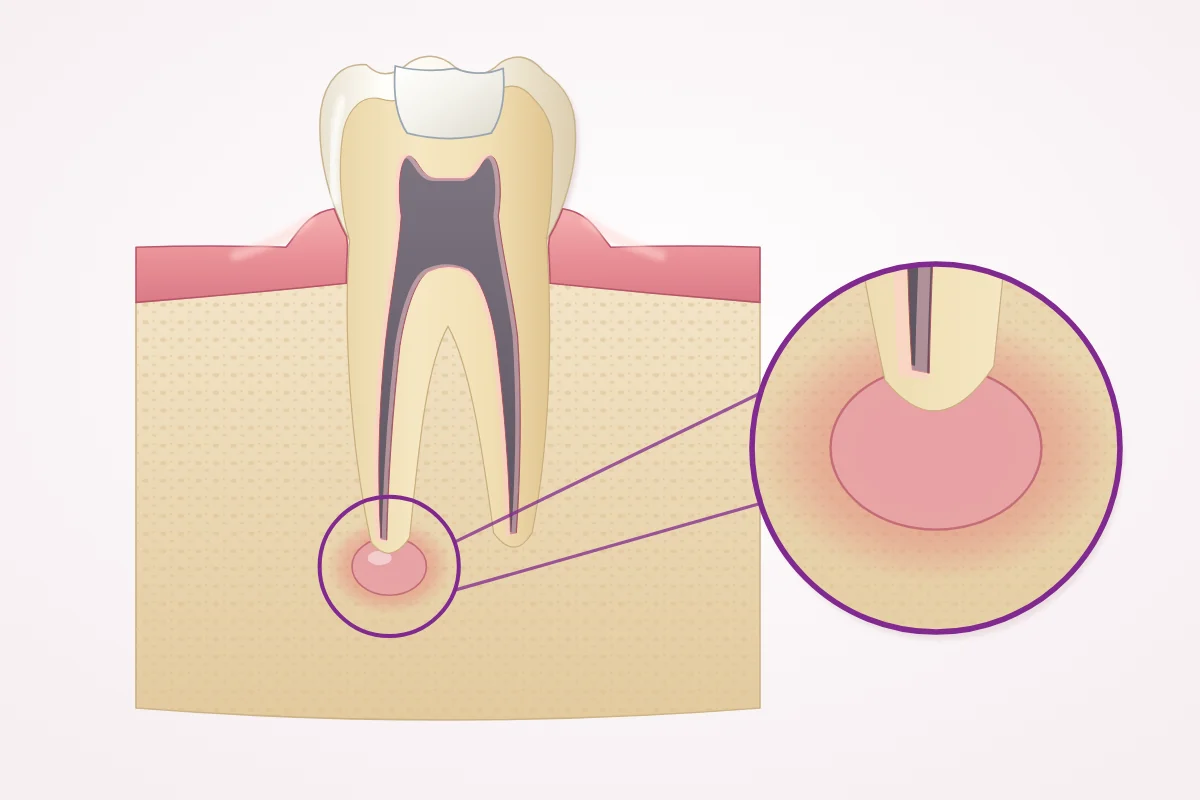
Examination
Your dentist looks at the tooth and gum, checks how the tooth reacts to tapping and biting, and asks about your symptoms.
X-rays
Digital X-rays show the roots and the bone around the root tips.
Pulp vitality test when needed
A simple test that helps show whether the pulp is still alive.
CBCT 3D scan when needed
For curved or extra canals, suspected cracks or retreatment, a 3D scan of one or two teeth gives your dentist a closer look.
Your options
Your dentist explains what they found and your choices, which may include root canal treatment, retreatment, root-end surgery, or removing the tooth and replacing it.
If radiation worries you: at our clinic, X-rays inside the mouth are digital, taken with phosphor plates and sensors that help lower the dose compared with film. Our Planmeca ProMax CBCT has an Ultra Low Dose mode, your dentist chooses the mode that suits each case, and X-rays are taken only when they are needed.
What happens, and how many visits

Numbing and placing a rubber dam
The tooth is numbed with local anesthesia. A rubber dam — a thin rubber sheet placed around the tooth — is used for every root canal treatment to keep the tooth clean and dry while your dentist works.
Cleaning and shaping
Your dentist makes a small opening through the crown of the tooth, removes the pulp, then cleans and shapes each canal. An electronic apex locator and X-rays help measure the length of each root.
Medication between visits when needed
If the canals need more time, medication is placed inside the tooth and the opening is closed with a temporary filling until your next visit.
Filling and sealing the canals
When the tooth is ready, the canals are filled and sealed. Your dentist then plans the final restoration, usually a crown or onlay.
Some teeth are finished in one visit; others need two or more, depending on the tooth, the number of canals and how much infection is present. Your dentist tells you the plan at the first visit. The root canal fee covers the first two cleaning visits; if your tooth needs more cleaning and medication visits after that, each additional visit has its own fee, which your dentist explains in advance.
If your root canal treatment was started at another clinic or in your home country, we can continue it here — bring any X-rays or records you have.
Would you like the tooth checked?
At the first visit your dentist examines the tooth, takes X-rays and explains your options before any treatment starts.
Technology and materials
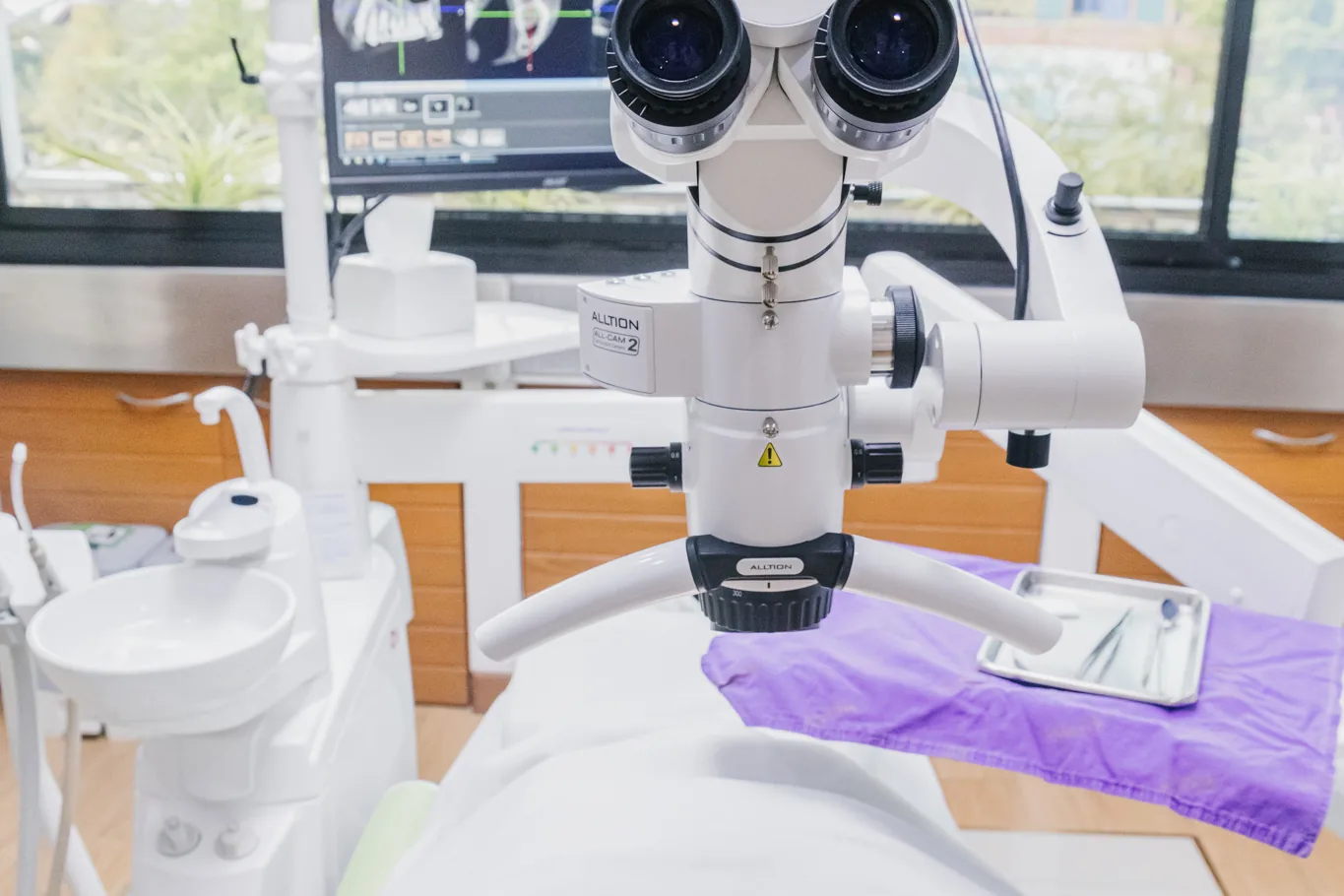
Dental operating microscope
Magnification and bright light that help your dentist see inside the tooth: narrow or hidden canals, old filling material and fine cracks.
Apex locator
An electronic device that measures the length of each root canal.
Rotary instruments (micro-motor)
Controlled-speed instruments for shaping the canals.
Obturation system
Equipment for filling and sealing the cleaned canals.
Digital X-rays and CBCT 3D imaging
To plan treatment and check the result.
Bioceramic materials (MTA, Biodentine)
Used when your dentist judges that a case needs them, for example in teeth with open root tips or to repair the root.
Laser-assisted irrigation
In selected cases, the Waterlase iPlus laser can be added to help clean and disinfect the canals. It is an optional addition that your dentist discusses with you first.
Your dentist decides which of these your tooth needs.
Root canal retreatment and complex cases

A tooth that was treated before can become sore or infected again — for example when a canal was missed, the seal has leaked, or new decay has reached the root. Root canal retreatment means removing the old filling material, and sometimes an old post, then cleaning, disinfecting and sealing the canals again.
Some first-time treatments are complex too: curved or narrow canals, extra canals, or canals that have become partly blocked. In these cases your dentist may use the microscope, a CBCT scan or bioceramic materials, and may ask a colleague with endodontic specialty training to treat or advise. Retreatment and complex cases carry an additional fee in addition to the root canal fee, which your dentist explains after the examination.
Other endodontic care
Pulpotomy
Removing only the inflamed part of the pulp in the crown of the tooth, as an emergency step or when the rest of the pulp can be kept.
Apexification
Treatment over several visits that helps an immature tooth with an open root tip form a barrier at the end of the root.
Injured teeth
A tooth loosened in an accident can be stabilized with a wire-and-composite splint while it settles, then checked for root canal needs.
Darkened treated tooth
A single tooth that has darkened after root canal treatment can be whitened from the inside (non-vital bleaching).
When root-end surgery is considered
Sometimes infection around the root tip continues after root canal treatment or retreatment, or a crown and post make retreatment through the tooth impractical. Your dentist may then suggest endodontic surgery — a small procedure under local anesthesia to remove the infected tissue and the root tip (root resection, also called apicoectomy) and seal the end of the root with a retrograde (root-end) filling.
After treatment
The first few days
The tooth may feel tender when you chew, and your jaw may feel tired from keeping your mouth open. This usually settles within two to three days. Contact the clinic if it gets worse after that, or if you notice swelling.
Protect the tooth
Chew mainly on the other side until the permanent restoration is in place. A temporary filling is a short-term seal.
Restore the tooth
Your dentist recommends a crown or onlay to protect the tooth from breaking, and a post when the tooth needs extra support.
Follow-up
Your dentist may take X-rays at later check-ups to see how the bone around the root is healing.
Cost of root canal treatment
Root canal treatment for front teeth, premolars and molars is listed on our prices page. Retreatment, complex cases, additional cleaning visits, microscope use, bioceramic materials, CBCT imaging and laser-assisted irrigation are added only when your tooth needs them — your dentist gives you a written estimate after the examination. The crown or onlay afterward is a separate treatment.
Prices on our prices page are shown as ranges. Your final fee depends on what the examination finds, and may include additional items — such as special materials — when your treatment needs them. Your dentist explains these before treatment.
Who treats you
Root canal treatment and endodontic surgery are carried out by dentists with postgraduate training in endodontics, including an American Board-certified endodontist. Our consultant endodontist, a Diplomate of the Thai Board of Endodontics, advises on complex cases. When your tooth also needs gum treatment, a crown or an implant, the dentists involved plan it together within the clinic. Treatment under the microscope and sedation options for suitable cases are available when your dentist recommends them.
Endodontic dentists
 Dr. Attapon SaeloMaster of Medical Science in Endodontics, Chiang Mai University
 Assoc. Prof. Dr. Warat LeelapornpisidMSc in Endodontics, Mahidol University; PhD in Endodontics, University of Manchester
 Dr. Tadkamol KrongbarameePhD in Oral Science and Certificate in Endodontics, University of Iowa
Consultant endodontist
- Dr. Pattama KitikusonDiplomate, Thai Board of Endodontics
Root canal treatment FAQs
Does root canal treatment hurt?
The tooth is numbed with local anesthesia before treatment starts, so you feel pressure and movement while your dentist works. Afterward the tooth may feel tender when you chew; this usually settles within two to three days. If you feel anxious, ask about sedation options for suitable cases.
How many visits does a root canal take?
It depends on the tooth. Some teeth are finished in one visit; others need two or more, especially molars with several canals or teeth with an infection that needs medication between visits. Your dentist tells you the plan at the first visit, and the crown or onlay afterward needs its own visits.
How much does root canal treatment cost in Chiang Mai?
The fee depends on the tooth — front tooth, premolar or molar — and on how complex the canals are. Root canal treatment prices are listed on our prices page. Retreatment, extra visits, the microscope or special materials are added only if your tooth needs them, and your dentist gives you a written estimate after the examination.
Do I need a crown after root canal treatment?
Often, yes — especially for back teeth. A treated tooth can become more brittle, and a crown or onlay helps protect it from breaking. Your dentist recommends the restoration that suits how much of the tooth remains.
Should I have a root canal or have the tooth removed?
Root canal treatment aims to keep your own tooth; extraction removes it, and the gap is usually filled later with an implant, a bridge or a denture. Your dentist explains how likely the tooth is to last after treatment, compared with removing and replacing it, so you can decide together.
What is root canal retreatment?
Retreatment means removing the old root filling — and sometimes an old post — from a tooth that was treated before, then cleaning and sealing the canals again. Your dentist may use the microscope and a CBCT scan to plan it. If retreatment through the tooth is impractical, root-end surgery may be an option.
Can you continue a root canal that was started at another clinic?
Yes. Bring any X-rays, records or a referral letter you have. Your dentist examines the tooth, takes new X-rays if needed, and explains how the treatment will be completed.
Why has my tooth darkened after a root canal, and can it be whitened?
A tooth without a living pulp can slowly darken. Whitening from the inside of that tooth (non-vital bleaching) can lighten it; your dentist checks the tooth first and may suggest a crown or veneer instead if the tooth also needs protecting.
Book a root canal consultation
Tell us which tooth is bothering you and for how long, or send a recent X-ray if you have one. A coordinator replies in English or Thai and books a time with a dentist. Open every day, 09:00–20:00 (Thailand time).
Or email us at [email protected]
Content reviewed by Dr. Pawak Tungthangthum — DDS, Chiang Mai University; Master's Degree in Esthetic Restorative and Implant Dentistry (International Program), Chulalongkorn University · Last reviewed