
Your stomach tightens when the appointment reminder arrives. You have rescheduled twice. The sound of a drill, the thought of the needle, or just lying back in the chair with someone looking into your mouth is enough to make your hands go cold. And the longer you wait, the more embarrassed you feel about the state of your teeth.
If this sounds familiar, you are in very large company. A review of 31 studies covering more than 72,000 adults estimated that roughly 15 in 100 adults worldwide have dental fear or anxiety, and about 3 in 100 have it at a severe level. It is common, it is understandable, and it is something dentists are used to helping with.
This article explains where the fear comes from, how to tell how strong yours is, the cycle that makes it grow, and what actually helps: things you can do before and during a visit, techniques that studies support, how local anesthesia feels, and the two sedation options at the clinic, inhaled and oral, with their limits.
In short: tell the team that you are afraid when you book, agree a signal to pause, say that you would like to start gently, and ask about sedation if you would like it. Starting early, even with a small first visit, usually keeps both the fear and the dental problem small.
How strong is my fear? A quick self-check
Prefer a number? The five-question dental anxiety self-check (MDAS) gives a score in about a minute. It is a screening tool, not a diagnosis, and your answers stay on your device.
Dental anxiety self-check (MDAS)
Nervous but able to go
- You feel tense in the days before, but you keep the appointment.
- Specific things bother you, such as the sound of the drill or the needle, and it helps when the dentist explains first.
Putting it off
- You have rescheduled or cancelled more than once, or you have not seen a dentist for a long time because of worry.
- You go only when something hurts.
- You feel ashamed of your teeth and that stops you booking.
Strong fear: ask for extra support
- You avoid the dentist even with pain or swelling.
- Your heart races, you sweat or feel sick when you think about the visit, or you lose sleep before it.
- You have panicked in the chair before.
A short questionnaire called the Modified Dental Anxiety Scale is often used by researchers and dental services to measure dental anxiety. It asks how you would feel about situations such as being in the waiting room, seeing the drill, having a cleaning or having an injection. A version in Thai has recently been tested in adults at Mahidol University. A questionnaire is not a diagnosis, and this article does not score it for you. If the third group sounds like you, tell your dentist, who can plan with you and, if it fits, suggest talking to a psychologist.
Why many people are afraid of dental treatment
Fear of the dentist often has more than one cause: a painful or unpleasant visit in the past, fear of needles or the sound of instruments, feeling out of control in the chair, or embarrassment after a long time away. Knowing what worries you most helps your dentist plan care around it. Studies find that the fear often begins in childhood, and that it can be learned from a single bad experience or from watching someone else be afraid.
| What worries people | What studies and dental bodies note | What can help |
|---|---|---|
| Needles and injections | In an Australian survey, needles and injections were among the commonest triggers, and some questionnaires added an injection item because some people fear only this | Tell the team what worries you most and ask what is happening at each step, so you know what to expect |
| Pain | Fear of pain is one of the main reasons people stay away; many patients do not like to interrupt, even when it still hurts | Agree a hand signal to pause, and say at once if you still feel pain after the numbing |
| The sound of the drill | A commonly named trigger, and one that children notice more | Many people find that music through headphones helps; tell the team if you would like to try it |
| Feeling out of control | A theme repeated by patients awaiting sedation in a UK research project, along with powerlessness and shame | Ask for each step to be explained first, and use the pause signal whenever you need it |
| Embarrassment about your teeth | Often named together with the other reasons, and it keeps people from booking | Say so; dentists see every kind of mouth and the aim is to plan, not to judge |
The cycle that makes fear grow
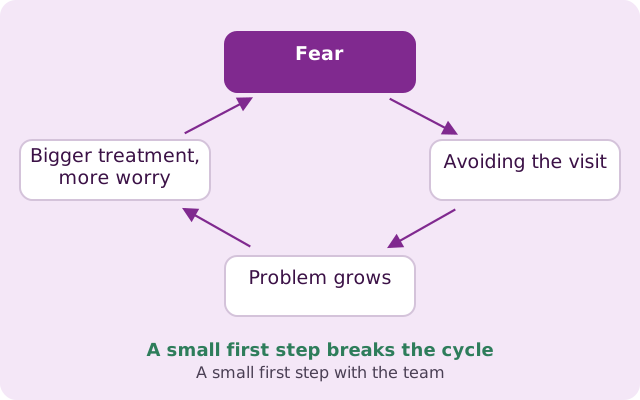
Fear leads to avoiding the dentist, avoiding lets problems grow, and bigger problems mean more treatment and a more worrying visit, which feeds the fear. An Australian survey of about 1,000 adults found this pattern in nearly 4 in 10 people with moderate or high fear, compared with about 1 in 100 people who were not afraid. The good news is that the cycle can be broken at any point, usually by a small first step.
Tell us when you book

When you book, tell the team what treatment you need and what worries you. They can set aside enough time and arrange a suitable dentist. If you are still unsure, you can ask on LINE, WhatsApp or by phone before you decide. If you would like to start gently, say so when you book, and the team will explain what the first visit involves.
| Step | What you can do | Why it helps |
|---|---|---|
| When you book | Say you are afraid, what scares you most, and any bad experience; mention that you would like to ask about sedation | The team can allow enough time and match you with a suitable dentist |
| Before the day | Sleep well, eat lightly, and bring a list of your medicines and health conditions; practise slow breathing | A rested body is calmer, and the dentist needs your health history to plan safely |
| When you arrive | Come a little early, tell the team again how you feel, and ask the dentist to explain the plan before starting | Knowing what will happen removes much of the unknown |
| In the chair | Agree a signal to pause, use slow breathing, and tell the dentist at once if you feel anything sharp | You stay in charge of the pace |
| Afterwards | Notice what went better than you expected, and book the next step while the memory is fresh | A good experience is how the fear gets smaller |
What helps during treatment
- Ask your dentist to explain what they will do and how long it will take before they start.
- Agree on a signal for a break before you begin, such as raising your hand.
- If you feel anything sharp or painful, tell your dentist straight away.
- If sitting for a long time is hard for you, treatment can be split into shorter visits.
The American Dental Association suggests two simple tools. The first is slow, even breathing: breathe in and out slowly for the same count, for about five rounds. The second is a body scan: relax your shoulders, then your arms, then your hands, one part at a time. Other ideas the association lists include listening to music or an audiobook through headphones, squeezing a stress ball, and picturing a calm place. Studies on music give mixed results, so treat it as something worth trying rather than a proven fix.
What research says about methods that reduce dental fear
| Method | What the research found | Notes |
|---|---|---|
| Cognitive behavioural therapy (CBT) | Reviews of trials found it reduces dental fear and dental phobia in adults; the evidence is of low to moderate quality | Delivered by a psychologist or trained therapist, often over several sessions, and a single longer session has also been studied |
| Facing the fear step by step (graded exposure) | A critical review of trials found relaxation and thought-based techniques worked most reliably when combined with facing the feared situation gradually | This is the idea behind starting gently |
| Clear communication and a sense of control | Recommended by the ADA and by Thai dental faculties; techniques that raise a sense of control worked in adults | Easy to try at any dental practice: ask for steps to be explained and agree a pause signal |
| Hypnosis | Results are mixed; one large review found moderate-quality evidence for lowering anxiety during oral surgery | Worth discussing with a trained therapist; named here because people often ask about it |
| Music, virtual reality, aromatherapy | A combined analysis found music lowered anxiety and pain, while a larger 2024 review of adult trials did not find clear support for it, nor for virtual reality or aromatherapy | Harmless to try, but do not rely on them alone if your fear is strong |
The sedation guidance from the Scottish Dental Clinical Effectiveness Programme makes a point worth remembering: there is no single approach that suits everyone, and non-drug methods should be considered first or alongside medicines. That is also how the clinic works: methods that help you stay in control come first, and sedation is added when it suits you.
Local anesthesia and what you feel
Local anesthesia numbs the area being treated, so during treatment most people feel only pressure. Some treatments can leave the area a little sore afterwards, which is common.
Many people dread the injection more than the treatment. A study that asked 247 patients to rate their injections found that the nerve block for the lower jaw was rated the most uncomfortable and injections into the gum for upper teeth the least, so it is not the same everywhere in the mouth. Ask your dentist to tell you what is about to happen, to wait until the area is numb before starting, and to stop if you still feel pain.
Sedation helps you feel calm, but it does not numb your teeth, so local anesthesia is still used with it.
Sedation options at the clinic
| Aspect | Inhaled sedation | Oral sedation |
|---|---|---|
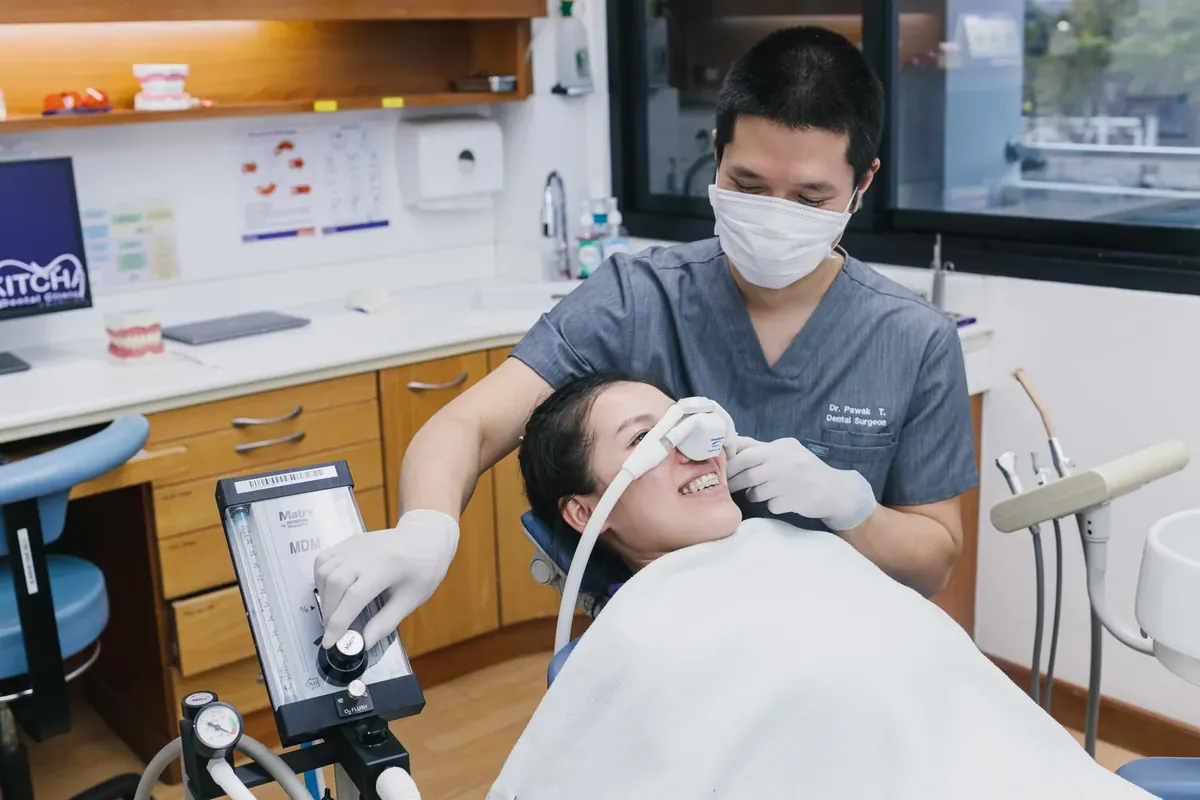
| How it is given | You breathe through a small mask over your nose, starting in the dental chair a few minutes before treatment | A medicine prescribed by your dentist, taken before treatment exactly as instructed |
| How it feels | Most people feel relaxed within a few minutes and can still talk with the dentist; the level can be adjusted during treatment | Calm and drowsy while still aware |
| How long it lasts | Wears off quickly once you breathe oxygen at the end | Lasts much longer, sometimes into the next day |
| Afterwards | You rest at the clinic until the dentist checks you; most people can drive or return to work the same day | An adult must come with you and take you home, you must not drive or ride a motorbike, and you should not drink alcohol |
| Cost | Charged by the time used and listed on the prices page under oral surgery | Your dentist tells you the cost before treatment |
With either option, most people stay aware throughout and can talk with the dentist. If treatment under general anesthesia is needed, we refer you to a hospital and coordinate your care.
Medicines of this kind do not remove the fear on their own. Reviews of oral sedation in adults found that the medicines reduced anxiety in many trials, but the quality of the studies was limited and higher doses brought more side effects, which is one reason the dose is chosen by your dentist after checking your health.
Sedation dentistry in Chiang Mai
Your health comes first
Your dentist reviews your medical conditions and the medicines you take before deciding. Please bring a list of your medicines and mention any breathing problems or a blocked nose. If you are or might be pregnant, tell your dentist: your dentist uses other ways to help you relax instead of the inhaled gas and oral sedation, and plans your care. Your dentist asks for your consent before using sedation.
Sedation is given by a dentist trained in it. A fingertip monitor checks your oxygen level throughout, and the clinic keeps oxygen and emergency equipment ready. If sedation is not suitable for you, your dentist suggests other ways to make treatment easier.
After your visit
After inhaled sedation you breathe oxygen and rest at the clinic until the dentist checks that you are ready to go. Most people can drive or return to work the same day. After oral sedation you must not drive or ride a motorbike, and you should not drink alcohol. Drowsiness can last into the next day, so plan time to rest.
Cost
Inhaled sedation is charged by the time used and is listed on the prices page under oral surgery. Your dentist tells you the cost of oral sedation before treatment. Sedation is charged separately from the treatment and only when you use it.
If it is your child who is afraid
Dentists at Siriraj Hospital advise parents not to threaten children with the dentist, an extraction or an injection, and not to promise things that may not happen, such as that it will be only a look. Preparing a child one to two weeks ahead with a story or a role-play, choosing a morning appointment, and arriving a little early so the place feels familiar also help. Starting visits when the first tooth appears makes the dentist an ordinary place. The clinic sees children from the first tooth.
Baby teeth coming in and falling out: what is normal and when to see a dentist
Myths and facts
| Common belief | What research and dentists say |
|---|---|
| Being afraid of the dentist is silly or rare. | Roughly 15 in 100 adults worldwide have dental fear or anxiety, and it is more often reported by women and younger adults. |
| The longer I wait, the more I can get it all done in one go. | Waiting usually lets problems grow, which means longer treatment and a more worrying visit. Starting small is kinder. |
| Sedation means I will be asleep. | With inhaled or oral sedation you usually stay awake and can respond. Treatment under general anesthesia is arranged through a hospital when it is needed. |
| Sedation takes the pain away, so I do not need an injection. | Sedation helps with worry. It does not numb the tooth, so local anesthesia is still used. |
| The dentist will judge me for my teeth. | Dentists see every kind of mouth. The aim is to plan the next step with you. |
If this sounds like you: what to do
These are example situations, not patient stories, to help you find the next step that fits.
| If you are… | Usually the next step | Worth asking |
|---|---|---|
| Afraid mainly of the needle | Tell the team when you book, and ask what is happening at each step so you know what to expect | What will happen at each step, and what will I feel? |
| Not seen a dentist for years and embarrassed | Say when you book that you would like to start gently; the team explains what the first visit involves | What is the most urgent thing, and what can wait? |
| Panicking in the chair before | Agree the pause signal, ask about sedation, and consider talking with a psychologist about CBT | Would inhaled or oral sedation suit my health? |
| Pregnant and anxious | Tell your dentist that you are pregnant; other ways to help you relax are used instead of sedation | Which relaxing methods can we use together? |
| Planning big treatment such as wisdom teeth or an implant | Ask about sedation early, so the time and the dentist can be arranged | Which option is suited to a longer visit? |
Questions people ask about fear of the dentist
Is it normal to be afraid of the dentist?
Yes. A review of 31 studies estimated that roughly 15 in 100 adults worldwide have dental fear or anxiety. It is more common in women and younger adults, and it is nothing to be embarrassed about.
What if I am too scared to even book?
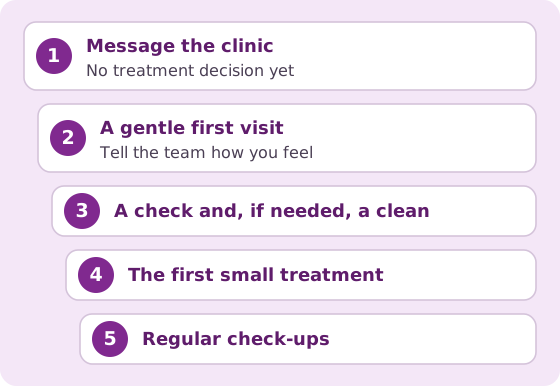
Start with a message instead of a call: write to the clinic on LINE or WhatsApp, say you are nervous, and ask what a first visit would involve. You do not have to decide on any treatment at that point.
Will it hurt?
The area is numbed with local anesthesia first, so you should feel pressure rather than sharp pain. Tell your dentist at once if you feel anything sharp, because more numbing can be given. Some soreness afterwards is common for some treatments.
What is the difference between inhaled and oral sedation?
Inhaled sedation works quickly through a nose mask, can be adjusted and wears off soon after. Oral sedation is a medicine taken before treatment, lasts much longer and needs an adult to take you home. Your dentist recommends an option after reviewing your health.
Can I drive home afterwards?
Not after oral sedation: you must not drive, and an adult must come with you and take you home. Inhaled sedation wears off quickly once you breathe oxygen, and most people can drive the same day after resting and once the dentist has checked them.
Is sedation safe?
Like any medicine, sedation has possible side effects, and it is not suitable for everyone. That is why your dentist reviews your health conditions, medicines and breathing before recommending it, and asks for your consent. A trained dentist gives it and your oxygen level is monitored throughout. Follow the instructions your dentist gives before and after the appointment.
Can I have sedation if I take regular medicines or have a health condition?
Often you can, and your dentist checks first. Bring your list of medicines and tell us about your health conditions and any breathing problem. Your dentist explains which option suits you and other ways to make treatment easier.
Do I need to tell you in advance that I would like sedation?
Yes, please mention it when you book. Your dentist needs to review your health first, and the appointment needs extra time. Our coordinators can also answer questions by WhatsApp, LINE or phone before you decide.
Summary
Fear of the dentist is common and manageable. The steps that help most are simple: tell the team, agree a pause signal, start small, and ask about sedation if you want it.
- About 15 in 100 adults have dental fear or anxiety; it is common and nothing to be ashamed of.
- Avoiding the dentist tends to make both the fear and the dental problem bigger, so a small first step matters.
- Tell the team when you book, ask for steps to be explained, and agree a hand signal to pause.
- Local anesthesia numbs the tooth; sedation helps you feel calm but does not numb, so both are used together.
- The clinic offers inhaled and oral sedation after a health review; tell your dentist if you are pregnant.
Sedation dentistry in Chiang Mai
References
American Dental Association (MouthHealthy): Anxiety
Scottish Dental Clinical Effectiveness Programme: Conscious Sedation in Dentistry, 3rd edition, 2017
Armfield JM. The extent and nature of dental fear and phobia in Australia. Aust Dent J, 2010
Faculty of Dentistry, Chulalongkorn University: Dental phobia (in Thai)